Collecting Praktica Cameras It Makes Real Sense Today
- Kamera Ostalgie

- Jan 16
- 12 min read

If you are thinking of putting together a collection of cameras concentrating on one make, then why not consider looking at Prakticas? They started just after the war, or just before if you include the Praktiflex, which we will do in this post and were still in production when the Berlin wall came down. They produced some fantastic cameras, can be fitted with great lenses, produced brilliant photographs, are relatively cheap to service and repair and at the moment are so cheap to actually buy it would be crazy to not collect them.

At the moment, on the current online market maybe only Chinon SLRs of the 1970's are as good value as the Praktica cameras are, but it won't stay this way for ever! Take a look at eBay, there are listings galore for Prakticas, and we in the U.K. because Praktica had such a massive market share here in the 1960's and 70's, are spoilt for choice today and most of them are going for relatively nothing.

Take this Praktica Nova I PL above for example, I bought this last February for £10.92, okay it cost me £16 with postage etc, but it is a lot of camera for £10.92. This is not the exception either, you could get similar cameras at similar prices every day of the week, time and time again. This was in full working order, the body is in virtually un marked condition and it had an original Pentacon flash bracket attached, which is what I was really after. What is more important I could go out with this now and get some high quality images from it, all from a camera that cost me less than the price of a film. It's crazy.

If we take into consideration the amount of cheap M42 lenses now available on eBay this makes collecting Prakticas an even better option and if the worse comes to the worse and one of your Prakticas goes down, then they can be repaired or serviced very reasonably compared to many other German or Japanese SLR's or you could of course just buy another working body cheaply.
The best thing about collecting Prakticas is the cameras themselves, the feel of the 50's and 60's models is great, they just feel right, solid, safe, dependable and above all very useable.

So what is out there to collect? Lets take a look.
We will start with the Praktiflex of 1938. The first series of Praktiflex cameras were landmark cameras, the second 35mm SLR to come out of Dresden in the 30's, after the Kine Exakta, but not as complex and much more affordable. However these could be fitted with the same quality lenses as the Exakta when they were new, but for a lot less money. If in 1939 you bought a Praktiflex fitted with a Zeiss Biotar then there was nothing to stop you matching the Kine Exakta with the same Biotar lens but you got an instant return mirror to boot and a Praktiflex with a Biotar would beat a Leica IIIb with an Elmar or the then new Summar hands down in the image quality department.
Today the first Praktiflex cameras can be a little pricey, in comparison with later models, especially the first type with the M40 lens mount, but if you move forward to the first Praktica model and the Praktica FX, FX2 and FX3 then the prices drop considerably. If you like to use as well as collect, then the FX 3 with its provision for taking automatic lenses has to be the best option as far as the waist level Prakticas go. However some later FX 2 cameras have the mechanism for the automatic diaphragm, so if you are wanting this feature specifically, then unscrew the lens and look at the camera body below the mirror, there will be either the mechanism which pushes the plunger on the automatic lens or just the solid body with the body number stamped there. See picture below.
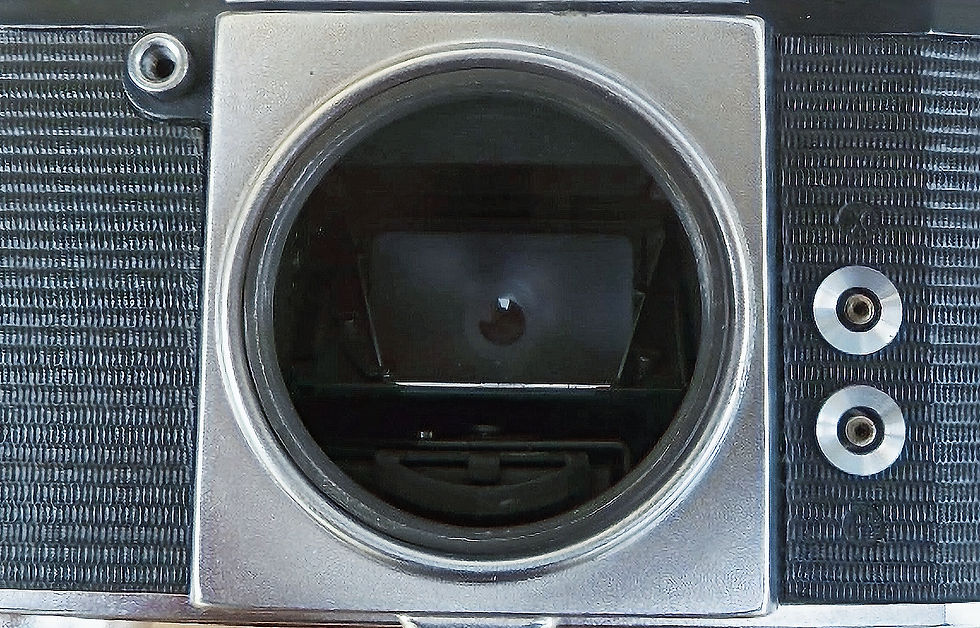
If your Praktica has this automatic lens facility, but you have older non automatic lenses you wish to use, don't worry you can still use the older non automatic lenses. There is a little red button that you can carefully slide to the right, this disengages the mechanism and enables you to use the older manual lenses as well. Just keep your finger off the mirror! There is not much room, so be very careful.

The best value for money among the early Praktica models is to my mind the Praktica IV series and all its many versions. The first type of Praktica IV with a fixed pentaprism and still a KW design, is my favourite as a collectors piece, but the slightly later IVF or VF have to be better as a regular users camera with the split image for focusing and the brighter Fresnel screen. But all the IV series cameras are well made useable in the 'modern' sense and great value today pound for pound.


The first version to me is the best looking of the IV series, with its black Pentaprism front, but the viewfinder is probably the more difficult to focus, being on the dull side with no spit image. If you do have difficulty focussing such cameras then the VF, IV M or an IV F or similar might be a better option as a regular user.

The IV F has a split image rangefinder and a Fresnel screen which is of course much easier to focus, whilst the VF has the addition of an instant return mirror. Both these models are much brighter then looking though the viewfinder making them far easier to focus than the original 1959 version.
Lets run through the Praktica IV and Praktiva V series, there are a lot of them and the models represented by the different letters can be very confusing.
the original Praktica IV of 1959. The K.W. Praktica with black prism front, no split image.
the later IV a Pentacon Praktica without the black painted prism and the K.W. logo.
the Praktica IV B, this is the IV but with built in lightmeter.
the Praktica IV M, this is the IV but with a split image rangefinder, great improvement for focussing.
the Praktica IV BM, this would be a great option if you can find one, as it combines the spilt image rangefinder with the addition of the light meter. Harder to find in the UK, I thing the GDR were reluctant to let them leave! More common now for sale in Germany, however the postage and taxes often are more money than the actual camera. How our crazy politicians today think it is alright to put VAT on something 60 years old that was already taxed back when it was new beats me.
the Praktica IV F, slightly later than the models above, the IV F has a completely new focusing system, with a rangefinder combined with a nice bright Fresnel screen. This new top model, seems to be much more common in the U.K today on the second hand market and is a good buy.
the Praktica IV FB is as the IV F, but has thee built in light meter also.
the Praktica VF is slightly later again, the main difference is the instant-return mirror, a major step forward for Praktica which enabled them to keep pace with the growing Japanese competition, and uprated shutter speeds.
the Praktica VF B, which is the VF with a built in light meter. Both the VF and the VFB had the new geometrical progression range of shutter speeds, also a new type of ribbed black body covering, and the little red triangular warning signal in the top left hand corner of the screen, letting you know that you needed to wind on! This feature appeared in the Exa range at the same period in time.
So that is it, at least 9 different models of the same camera that I know of, there may be more, but I have not come across them. There was a cosmetically different version of the IV which had a black line underneath the Praktica lettering, see image below, so if you like, that is ten Praktica IV models!

There are much less of these underlined IV's about even in Germany and for some reason they all, like the above example, seem very worse for wear cosmetically.
Beware of the German on line dealers selling 'rare' unnamed versions of the Praktica IV for 400 Euros. It's a scam, wipe any of the Praktica lettering with a cleaning solution and you have an instant 'unnamed' Praktica! That lettering even comes off if your hands are sweaty, so be warned, be very careful cleaning this lettering and don't fall for the 10 times price hike, its just dishonesty pure and simple I'm afraid. Sharks in every sea!

After the IV and V series came the Praktica Nova and Nova B, for the 1965 season. For some reason collectors don't seem to accept, or look at these Novas as vintage, classic or collectable cameras. I don't really understand why. After all they are Sixty plus years old, they look the business and if you get a good working example, provide the goods, image wise, yet the current market value is peanuts, Brownie Box Cameras are making more money, now I like my Brownies, but really, are they as good a classic camera as a Nova, it is just laughable! Come on, anyone with a little smidging of common sense can tell that Novas are under valued in the extreme right now!


Without getting on my soap box too much and yes I'm very biased, I have to admit, lets look at why not many people care about or rate the Prakticas of the 1965-70 period very highly.
To start with there was the stigma that they were made at the wrong side of the Iron Curtain, the terrible GDR! But it was the Germans that were designing them and producing them, not the Soviets. But the cold war feel and image stuck, so in Great Britain at the time, Prakticas were looked upon as eastern, Soviet, so they could not have been any good!
The Soviet ruling authorities wanted western currencies so subsidised the price of these Prakticas to bring in the foreign currency, so they were cheap on the British, Dutch and American markets not because they were badly designed or poorly produced, they were cheaper because they were heavily subsidised.
To make things worse the big photographic chains like Dixons and similar outfits, slashed the prices even more, which sort of backed up this perception that they were cheap, poor quality items, in the eyes of the public.
The massive market share that Praktica had, particularly in Great Britain and also in Holland, meant they were quite common when new, and again, today on the classic camera market they are still available in great numbers compared to many other of their contemporaries. Which tends to make them less sought after.

In more recent times Author and Photographer the late Ivor Matanle whilst praising the IV series really slated the Nova and later series of cameras, so wrongly influencing the collectors of the 1990's at a time when Prakticas should have been looked at with open minds not false stereotypes.
Going on from that, whilst I really enjoyed his book, Ivor Matanle did not help the Praktica reliability issue either with his comments, yes many Prakticas today are in poor condition, but that is because they were sold cheap when new to a different customer base than the more expensive cameras had and that different customer base did not value or look after their Praktica Nova like customers who bought a Pentax or a Cannon for example. It was not the actual quality of the Praktica that let them down, it was the life that they had and the environment that they were in after they were made, not the quality control levels provided whilst being produced.
Quality control at Pentacon was quite high, in fact they employed women on the factory production line to put the cameras together on purpose, as they were better at it, and took far greater care doing it. They had a research and development department and lent out or gave cameras to the top photographers in East Germany at the time, to get their feedback and note any potential problems. So it was a myth that there was no quality control or customer feed back.
Bluntly, a lot of the original customers were the problem, not the cameras themselves.

Introduced shortly after the Novas was the Prakticamat in1965. This was the first Praktica with through the lens exposure metering, a great step forward for Praktica at the time. The Prakticamat is the only camera of the Nova series that still commands a high price today. There are very few coming up for sale on line at the moment, and will probably cost you between £100 and £200 pounds ! Why so expensive? I'm not sure, maybe because they were a landmark camera? It does not make sense to me, they made over 25,000 of them so they are not scarce or rare, maybe it is because many of them have the better quality Oreston 1.8 50mm lens fitted, who knows? It is a bit silly as the similar specification Super TL can be purchased for between ten and fifty pounds! The Super TL is much more common, as Praktica made over 500,000 of them, which could well be one of the reasons for the current large price difference!


I suppose it all depends on which hat you are waring, put your collectors hat on, then the Prakticamat was made in far fewer numbers, so would be the one to go for, but with your users hat on, the Praktica Super TL of 1968 makes more financial and practical sense for a similar specification camera and similar photographic results. You could of course obtain one of each and do a proper comparison! I don't have either models in my collection at the moment, but it would be a great idea for a future post!
After the original Novas came the Nova I and the Nova IB. The IB of course had the addition of a light meter. I suppose the main difference is that the two Nova I's had a new shutter speed control, which consisted of just one shutter speed dial as opposed to the separate fast and slow dials on the earlier Novas, which was a carry over from the Praktica IV and V series. They also had the new Praktica quick load film loading system along with the Super TL which was supposed to make film loading easier.

I read in a recent article on the internet the Praktica Nova I being described as the worst Praktica ever. A strange claim, what is there not to like about this Praktica? The shutter speed selection is much simpler, the film loading improved, I like the Praktica Nova I, it's sturdy, simple and straightforward, it usually comes with the Meyer-Optic Domiplan lens, which again I rate highly despite the modern perception that it is a poor lens and the Nova I is currently a bargain on todays vintage film camera market.

The other thing I rather like about the Nova I is the focusing screen, both my examples seem really nice and clear when focusing. According to praktica-collector.de which is my favourite Praktica site, there were 136,000 of this model made, between April 1967 and March 1972, so quite a long production run. The designer was of course Mr Herbert Welzel.
From what I understand the PL part of the model name refers to Pentacons then new Pentacon Loading System.
Of course you do have to be very careful when buying a Praktica on line as physically inspecting and trying them yourself is usually not possible. The pictures and wording have to be studied very carefully, ask loads of questions and evaluate the response. Avoid sellers who say the camera is not tested or they can't test them, that usually means that the camera is faulty, especially sellers who say that, yet are selling lots of cameras and must have photographic knowledge or they would not be doing it. Look for cameras that look like they have come out of a house clearance or just been put away for years and are now being sold, usually with a case or holdall a flash gun, instructions and a cheap tele converter, you know the ones I mean, and check the sellers other items, if they are all just general things there is much more chance of the camera being decent, than if they look to be dealing in cameras but say they can't test it.
If after getting your new vintage Praktica and it does have a few faults despite all your efforts to get a good one, think about getting it fully professionally repaired and serviced. Such a camera will then last you years, look after it use it and enjoy it. A newly serviced camera is a joy to use, believe me the difference is unreal.


There is another PL Nova, it's called the PL Electronic, I have never seen one, only in pictures, but maybe one day I will get my hands on one ! Made for less than a year during 1968 to 1969, only around 3400 were made, so quite rare as Prakticas go. It's main claim to fame was it's electronically controlled shutter! Now that would be worth putting a film through!

In 1970 the Praktica L series appeared with the Praktica L and LLC. The cloth shutter gave way to a metal shutter, the shape became angular, it was a whole new direction, so we will pause here and produce a further post for the later cameras of the 1970's onwards, otherwise this post will turn into a book!
Now that is not a bad idea!
Take care,
Phil


Comments