Copy of The Agfa Jsorette, Jsolette, Isolette or Soldatenkamera Circa 1937-1942
- Kamera Ostalgie

- 14 hours ago
- 10 min read
This post has been re-published once again today, Friday August 28th as new information regarding the body numbers has come to light. It now has three up dates with new information.

I suppose the German wartime camera that is most well known today are the Leica 111 / 111C types with various military markings engraved on them. Some genuine, some not! But for the ordinary German soldiers in WW2, the Agfa Jsolette was said to be the post popular, and it got the name of Soldatenkamera attached to it.
I suppose it makes sense, black, compact, foldable, easy to put in a soldiers uniform pocket and of course it was new and readily available. The cost in RM was between 58,00 and 66,00 depending on lens and shutter.

It was also a quite striking camera at the time of introduction which seems to be in very late 1937. Initially the name was called Jsorette, but was changed to Jsolette part way through production. Sources differ as to exactly when production ceased, some saying late 1940, others 1942.

However I have also heard from my sources in Germany that directly after the war ended some 'Pre war' style Jsolettes were produced in late 1945 early 1946. These can be identified by a metal re-wind knob instead of the usual black. This version does not seem to be logged in any articles on line I have read, or in books and I have fairly looked into it, but yes there is a post war version of the pre-war model! If you get my drift.


There is another twist to the tail! Some, or maybe most of these have a top made of Hydronalium painted black to look like the prewar black Trolite top plates ! Oh nothing is ever simple when you look into camera history! Trolite was a German equivalent to Bakelite. In Germany it was spelt Trolit, in English, Trolite. What is Trolit or Trolite if you prefer, well it is a type of cellulose nitrate plastic produced at the RWS company Rheinisch-Westfallisch Sprengstoff-Fabriken in Germany.
Technically its composition is different to Bakelite, though it is a similar looking finished material, so maybe we should just call it Trolite to be accurate! So Trolite it is.
I know what you are thinking now, you're thinking what then is the replacement top plate material, this Hydronalium then? Well, & I had to look this up, it is a type of aluminium magnesium alloy material, originating in Germany in the 1930's.
Which was then in Agfa's case painted over with black enamel to make it look like Trolite!
There, you would not get this amount of detail in any other camera blog! All I need to do now is get my hands on a few of these 1945-1946 Jsolettes to confirm the stories!!!

Now just to make everything complete, or maybe confuse the issue even more, how about the American version of the Jsolette? Ansco produced quite a few versions of the Jsolette called the B2 Speedex with various lens and shutter combinations. Okay it might be pushing it a little, but to me they are clearly built around the pre-war Jsolette, just look at the style and position of the neck strap lugs if you have any doubts! Anyway it might be better left for another post and post is the problem, getting one to the U.K. the cost of shipping from America is stopping me buying one to compare!

I would love to get my hands on one of these to compare them! Anyway, I'm digressing again, but I hope you agree that they are interesting!

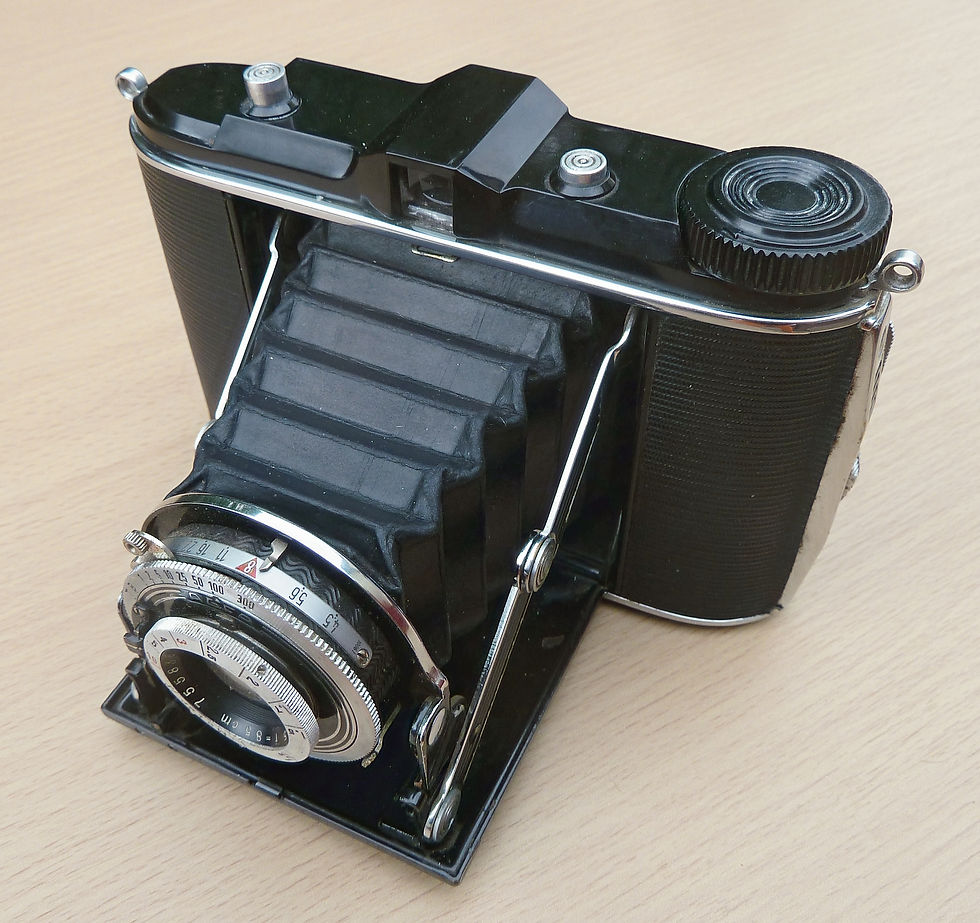
Right, back to the German versions and lets have a look at the lens and shutter of the Agfa Jsolette I have in front of me now.

The shutter is a well speeded Compur shutter with speeds of 1, 2, 5, 10, 25, 50, 100, and 300th of a second plus T and B. so a really good shutter though it could do with a clean and service today. The lens on this example is the Agfa Apotar 4.5 of 8.5cm in length. Focus is done by the front ring and ranges from 1 meter to infinity.

On the focus scale 3 metres and 10 meters are marked in red along with f8 on the aperture ring. The focus scale on this example is almost seized up and looks slightly out of square with the rest of the camera. It seems this is a common problem today with these pre-war Jsolettes, the cause of it seems to be that the grease dries out over time, causing the focus to seize up solid eventually. So we won't be putting a film through this example any time soon.

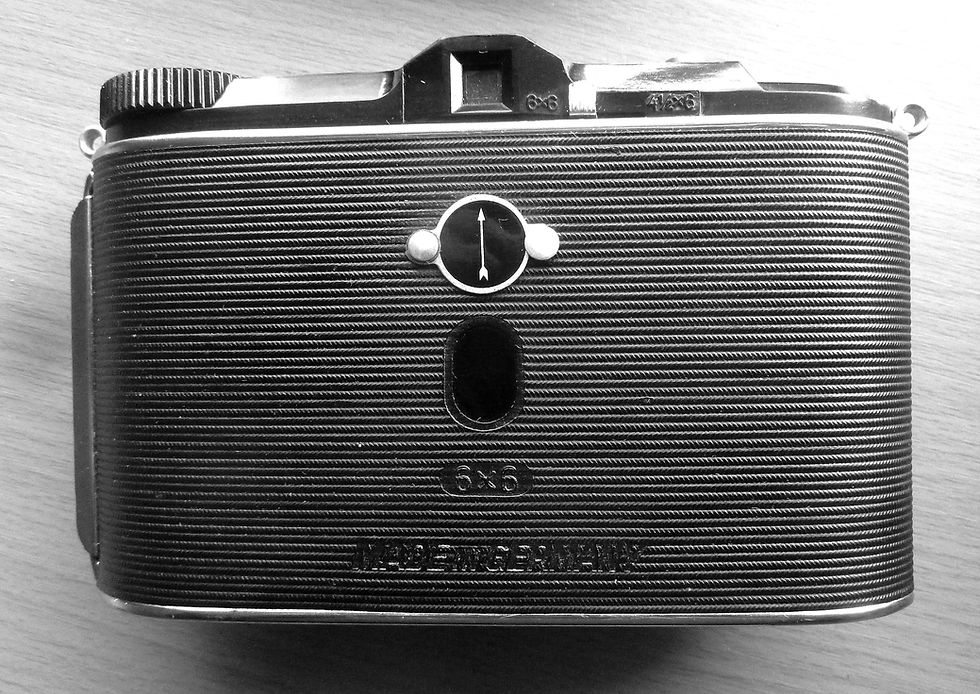
Looking at the camera from the back we see the little lever with which to change format from 6x6 to 4.5x6. This alters the viewfinder to the selected format and there are two masks under the spool recesses which you just flick out to change to 6x4.5.


The camera body number is on an unusual location, engraved into the spool holder as seen above. I have as yet not worked out what these numbers represent, but there are quite a few different number / letter codes. I'm sort of thinking on the lines they are production batches or time periods, but as yet I can find out very little about them. If you understand them please let me know.
The Agfa camera museum in Germany have one with numbers 6A 315/6A 3195 made in 1938 and 7Q 1571 from 1939/40.
The more you search for information on these cameras, the more confusing everything becomes, like this example below.

Compur Rapid with Solinar 8.5cm 4.5 lens!
Wow, what a spec this one has. I did not know until today that this version existed! The Solinar lens was extremely sharp, this must have been some camera in its day. The Compur-Rapid having a top speed of 500th of a second.

Most that are seen, are with Gauthier Shutters like the one above, this one coupled with a 8.5cm Jgestar 6.3 lens.

Or this one with Gautheir shutter with top speed of 175, and a 8.5cm Agfa Apotar of 4.5.
The variations seem endless. Anyway lets continue our look at the version in front of me.

The viewfinder in the Trolite top plate is nice and clear compared to some folders in the 1930's. The little lever shows the 6x6 image when pushed to the left and the smaller 6x4.5 image when moved over to the right.

On the left side of the top plate we have the large knob for winding on the film in the direction of the arrow. The silver button opens the camera door allowing the lens and bellows to pop out automatically.

On the right side of the Top plate is the shutter release. The Trolite has just chipped away slightly here. You often see some damage to the Trolite top.

The film winding knob lifts up to enable the film to be removed with ease..

On the covering of the door we have the Agfa diamond and the name Jsolette underneath it. No mistaking the make or model.
So that is about it the German 'Soldatenkamera' of WW2, the first of the Agfa Isolettes that continued in various forms through the 1950's.

The good thing about the pre-war Jsolettes is that the bellows are made of leather not that horrible shiny cloth plastic combination that most of the later ones were fitted with, that are now all split and holed, so you have a chance of them still being light tight today.

If you get the chance, check one out!
Take care,
Phil
1.11.2025 Quick update
Just a quick update here from the team at Kamera Ostalgie.
We have managed to get our hands on another version of the Jsolette to do a more detailed comparison. At great expense and fighting off loads of stiff competition from other wartime Jsolette collectors, Kamera Ostalgie gives you this....

...which is a Jsolette with body number T 6G 1072. It has an Agfa Jgestar 6.3 lens of 8.5cm in a simple 4 speed shutter comprising T, B, 125, 100, 50, and 25th of a second.

There are a few differences to my other example, the focus scale is in feet as opposed to metres and on the back is stamped Made In Germany in the black covering.

Another is the different sized tripod bushes as seen below.


There is nothing much different here apart from the white letter D on the door, I'm not sure what the significance of that is.


I would love to know what these body numbers mean, if they are indeed body numbers. I think you can date the camera by these letters / numbers but I can't work out just what they mean. I have looked all over for the answer, but as yet it has eluded me !


Okay, that is all for our little update, I hope you found it interesting. Oh I had better come clean then, there was no stiff competition for this wonderful war time Jsolette, from bands of eager early Jsolette collectors, in fact nobody else bothered to bid !
All I need to do now is have them repaired and get some film through them, see what they can do.
Phil
2.2.2026 Further new up-date
One of Kamera Ostalgies regular readers has found one of these pre war Jsolettes, it is slightly different to the one featured in our last up-date, and we have pictures which we would like to share with you all. If anyone else has one and would like to send in pictures with a body number please feel free to do so and I will put them on the post.

This lovely example is very similar to the one featured in the last up-date, but the shutter speeds are different, no 125, and the distance is in meters not feet.

The body number is T 7H 2674. Does anyone know anything about these series of numbers
and letters? If you do please share the mystery!


It looks a cracking camera in very smart condition, I hope you enjoyed the pictures of it. I like it, nice and simple, three speeds, what more do you need!

I hope you found the two recent up-dates interesting. If you have any information that you would like to share on these Agfa Jsolettes, pleases feel free to do so !
Third up-date 28.8.2026

The mystery of the numbers and letters on the alloy spool holder on the Isolettes and what the numbers mean has been bugging me for ages, I can't seem to find out what the series of numbers and letters mean on each camera and relate it to a date. However I have found a little more information, so I will add it here.
It seems that they are not a serial number in the conventional way of most manufactures, but they are some sort of production serial number that Agfa used to track manufacturing batches. It seems the cameras were produced in batches rather than continuous runs.

It seems the first three figures, (lets use one of my cameras T6G 1072 as an example,) T6G is the cameras letter prefix, which identifies a production batch or even maybe a sub-batch.
The numbers 1072 are the sequential numeric identifiers of this individual camera of that production block. It has been suggested that a batch or block could be anywhere between 0 and 25,000 cameras, but so far I have only numbers in four figures not 5. But my sample of numbers is small.
So on my other example 7 G 0880, 7G would be the batch or block, and 0880 the sequential numeric identifier, or actual camera body number if you like.

The reason for these manufactures codes are so that the factory or any official dealer or retailer could identify the camera it's year and what batch it was produced in.

Then we become a little unstuck! If the factory database is lost or destroyed, like in times of war or take over etc, then the code lovingly stamped on each camera is at best difficult to understand or worst case scenario, tells us nothing at all! It seems, as far as I can make out, that the original factory log is lost, so the only way to collate the production run and year would be to try and log all surviving examples and work back from there which may give us an approximate date. But it would be a big undertaking. Hopefully the factory database or log will turn up at some point.
I wonder, did the American Agfa version of this camera The Agfa/Ansco Speedex use the same code system? As yet I don't have any examples to find out from.

Another un answered question has come to mind recently. We know just after the war, late 1945 and 1946 some examples were produced with an alloy top plate painted black to look like the Trolite top plate of 1936-42 period.
However pictures recently have come to light of a very early example with the black Trolite top painted silver to look like alloy!!! This is a very early Jsorette named example from the very beginning of production. Take a look, its a rough example, what do you think?


It looks like the camera number is 5 P 340 there may be another number after the 0 ?

Yes, it could have been painted anytime after it was produced, but why would you ? And, if it was repainted not by the factory, why are there no traces of overspray, bad masking or brush marks? The viewfinder is perfectly done, this leads me to think it is from the factory and originally Agfa were going to paint the top plates to look like alloy, but soon changed their minds for some reason or reasons. Cost? Production speed? Lack of good paint adhesion? All possabilities!
Of course I could be wrong and this was painted by little Fritz with his tin of Humbrol enamel and his little paintbrush from his water colour paint box set. But I don't think so.
It is very early and there is no made in Germany stamped on it anywhere so it is a home market model.
That is the latest up-date more or less complete. I wanted to bring it up to date before the blog closes at the month end. This is my favoutite post and it was the most fun to write and research, so it just had to be up-dated!
Take care,
Phil


Comments