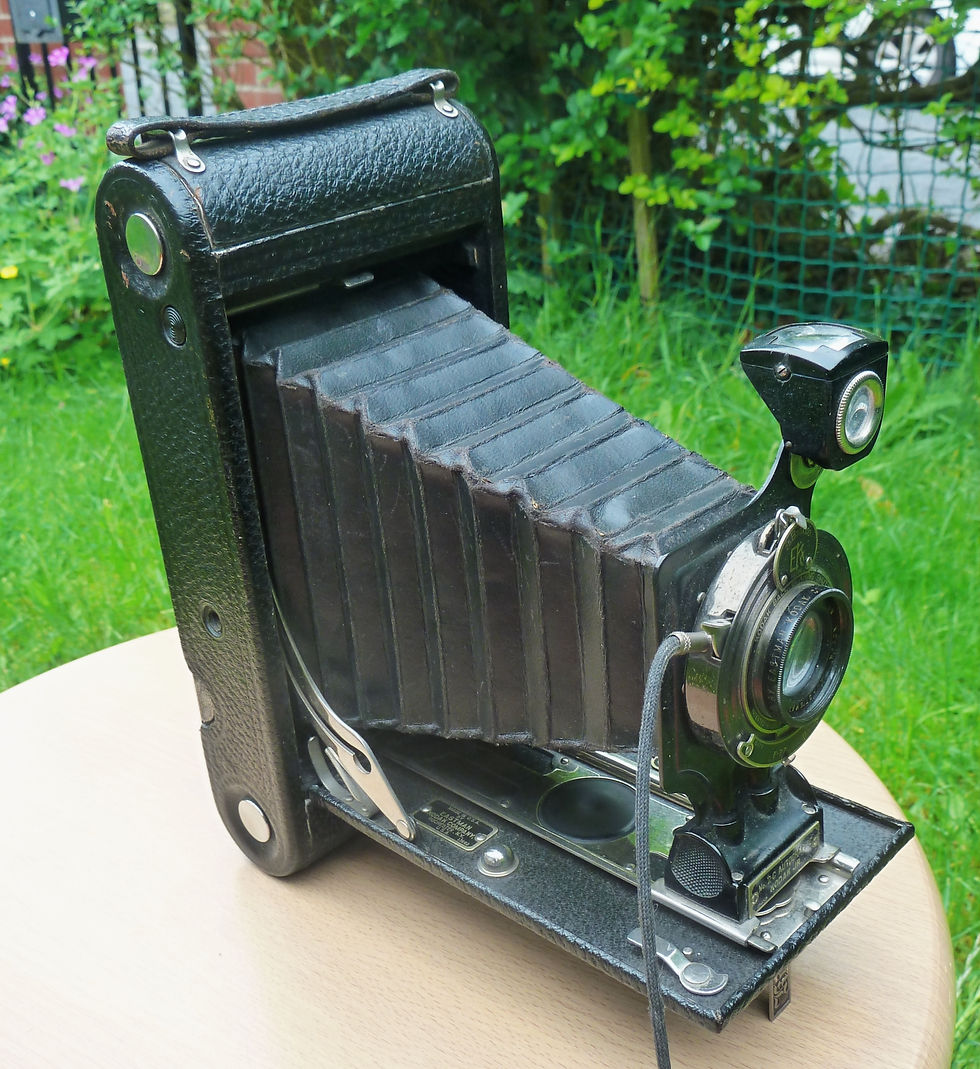
No 2-C Autographic Kodak JR. Made by the Eastman Kodak Company Rochester New York U.S.A. 1916-1926.
- Kamera Ostalgie

- Jun 16
- 5 min read
Updated: Jun 20

I first started collecting vintage cameras in 1977 when I was 16, with my first weekly wage packet I bought a Box Brownie for £1.50 and a Blue Ensign Box for 50p. The most common cameras at local Antique Fairs were Box Brownies and Folding Kodaks like the one above, Box Cameras were usually £2 or below and Kodak folders were about £5, there were lots of both available, and to me at 16, I thought they were great!
To be fair, they were, and still are great, but you know how it is, you get further into a hobby, you join a collecting club, I joined the PCCGB, read loads of books, get influenced by others, then you drift off up-market, and end up buying expensive cameras and no longer look at the humble Folding Kodak or Houghton Ensigns, but looking back it was much more fun with just a few quid in my pocket going to house clearance sales and antique fairs and flea markets and just seeing what, if anything was there.

So lets have a quick look at a typical Kodak folder, in this case the 2-C Autographic JR. Introduced about 1916 just after the Autographic feature was brought in, this model was made for around 10 years, though there are many minor variations.

So, just what was the Autographic back and what did it do? It allowed the photographer of the time to write a short title, date or other caption onto the negative, via the film backing, by using the metal stylus or pen provided, which is often lost on surviving examples today. This writing would appear on your finished print. You just flicked open the metal plate pictured above, wrote on 'Uncle Harold 1917' and that would appear on your finished print, so you would never forget the mugshot was of Uncle Harold in 1917! Brilliant. In reality either many people never bothered using it or processing firms missed off the writing when printing the positive, as very few original pictures survive with the writing on when you think how many of these Autographic Kodaks were in use between the wars. A brilliant feature never the less.

The next thought that comes to mind, was what was A-130 Autographic film? Well A -130 was a very popular film in its day giving 7x12 cm images or 2 7/8ths x 4 7/8ths if you like it in good old inches, sometimes this size was called Postcard size. A 130 film started production in 1916, and soldiered on until the year I was born, 1961.

I guess a lot of these prints from this A-130, would have been just contact printed? Great, no need for an enlarger, no loss of detail, sounds ideal!

Check out this old advert for the Kodak 2-C Autographic

The example I have in front of me has the Kodak Anastigmat lens of f7.7, the most expensive option in the advert above, at the sum of $19.00, which in 1916 would, I suppose have been a fair bit of cash. According to one internet source I looked at, that would be $580 today!

The patent dates are quite interesting, June 19th 1917 being the latest date. Also the camera was patented down under in Australia, March 19th 1915, which is interesting to me, as the original case for this camera is made in Australia ! No, I'm not joking! Look.......

There must be a story here somewhere. American camera, but the case is Australian, so either Kodak imported its cases for the 2-C from Australia, or 2-C cameras were exported to Australia market without cases and the cases were produced locally in Australia, more probable, but...

....not when the lock on the Kodak 2-C case is made in the USA ! Hehe sort that one out, I'm not going to try, but if you have any theories or even better facts leave them in the comments!
I know the case is original to the camera, I bought the camera over 45 years ago direct from the house clearance auction of a deceased estate, so it has never been near a dealer or a collector in its life. I'm the second owner!

Lets get back to the actual camera, have a look at it's features.

The shutter is one of Kodaks own 'Ball Bearing Shutter', it's numbered, carrying the number 14226. It has speeds of B and T plus 25, 50, and 100th of a second. The lens, which as mentioned is a Kodak Anastigmat of f 7.7 and is of 152mm. 64762 is the lens number. The aperture plate also carries a number16478. The name plate carries a number too, 13458. Oh this is much better than train spotting with all these numbers. The Ball Bearing Shutter has two patent dates Jan 18 1910 and Jan 7 1913. Apertures are 7.7, 11, 16, 22, 32, and 45 ! Stroll on, I bet a negative taken using a tripod and cable release, stopped down to f45, is has sharp as hell. Imagine a contact print off such a negative.

Kodak loved putting numbers on these early folders, even the focus plate has a number. 16476!

I love the attention to detail in these cameras, the numbers, the little plates, the high quality plated fittings etc, they really are nice cameras, okay you can't get A 130 Autographic film anymore to use them with, but a collection of these early Kodaks in a cabinet would look fantastic today as a display. The cost of such a nice collection would not break the bank either.

So don't overlook them, there is a lot to like about folding Kodaks made between the wars.

I hope you enjoyed this ramble into folding Kodaks, if you did then let me know in the comments, I might feature them again very soon. I have one or two more to dig out!
Phil
Similar posts on Kodak Folders you might find of interest.


I had not realised I had done some many Kodak posts ! Anyway feel free to take a look. I do rather like these old Folding Kodaks !
Phil
pages, brilliant!
Phil.


Comments