Voigtlander Vito II. A neat, nice quality German 35mm folding camera from 1949.
- Kamera Ostalgie

- Feb 28
- 8 min read
Updated: Mar 10


Well, let us start by looking at the case, it is not your usual Vito II case, the leather is quite heavily grained, and the design is one I have never seen before, the way it
opens is quite unique. It does not open from the back at all, it opens from the front at the left side as you look at it in the picture! Which is rather unusual. The stitching is slightly uneven, as though it has been stitched by hand. It might have even been made locally. The way it opens makes me think a photographer has designed this case, not a case manufacturer!

It opens in a very unusual manner, the top just pulls open and is allowed to drop down, it is sown on, so is still attached, then you open the brass press stud the front drops down and you can open the camera ready for action. This is an ever ready case in the true and literal sense of the word.

A proper ever ready case! Not the usual type which we used to call never ready cases! I have a little theory about this case, which we may go into a little later. But right now, lets look at the camera.

This camera belonged to my late Father, it has been missing for years, but I located it a couple of days ago, much to my delight, I thought this had long gone. So as it had unexpectedly turned up, I decided yes, lets have a look at it, clean it all up and write a post! So here we go!
Voigtlander were really a German film manufacturer, who also made cameras, it was quite a common set up in Europe at the time, Agfa, Kodak, Houghton-Butcher, Ferrania all did similar things, as did many others, basically I suppose the idea was produce cameras, because more cameras meant more film sales and film sales was where the real profits were made.

Lets go back to mid 1930's Germany. Germany was back on its feet, after World War 1
and the high inflation of the 1920's, the economy was on the up, things were looking up for the average German. 35mm cameras were just starting to appear in the mid to late 1930's, Ihagee had fired up interest in miniature cameras with the introduction of the Kine Exakta. Other manufacturers were keen to follow with their own versions of new miniature 35mm cameras. Kodak jumped in with the Nagel produced Retina folding cameras, and miniature camera interest and sales rocketed. Voigtlander responded with the Vito folding camera in the late 1930's. The camera is now sometimes referred to as the Vito I, but as far as I'm aware at the time it was just called the Vito.

These early Vito's were designed to take Voigtlanders own film called Voigtlander Bessapan Feinkorn, which was 35mm film, 24x36 mm images, but the film had no perforations!

Inside the camera it even had the type of film to use cast in as part of the camera body.

Two of these examples show the lettering quite clearly, but not all of them had this, look at the middle picture, here we have just a plain smooth area, no raised letters here. I'm guessing that the plain one is later, say 1947 to 1949, but it is a hunch, a guess only, not a backed up fact, while the ones with the Bessapan film writing are pre war or war time. What do you think? The lens above is number 2,729056, trouble is sources on the net don't actually agree on the dates of the lenses, so we can't accurately date them just by lens number.


The first Vito is said to have some reliability problems, before the Second World War stopped its development. Now as yet I have not had the pleasure of using the original Vito, so I can't really comment, as cameras can get this reputation without any true facts, I would love to get my hands on an example to use, see if the negative hype is correct though. The original Vito re appeared after the war, then was quickly followed by the Vito II which came out in 1949.

By the time the Vito II came out in 1949 it had gained a film sprocket wheel for 35mm perforated film and interestingly the writing was no longer there, which again points to the original model Vito's with no writing were the later, maybe post war ones?
A advert for the Vito from 1940, the hinged yellow filter that you can see here is usually missing from examples on sale today.

The advert below comes from 1941

This one dates from 1942, so the original Vito was still for sale quite well into the war.

Okay, back to the Vito II in question!

I suppose the main difference between the Vito and the Vito II was the lens became the Colour-Skopar instead of just the Skopar, the actual difference in the lens was now the new Color-Skopar became a coated lens, to make it better for using colour film, which was becoming much more popular. The cameras was of course now designed for perforated 35mm film instead of the pre war unperforated film as previously mentioned.

It seems that there were many variations made to the Vito II throughout its production run between 1949 and 1955. The camera came out with two shutter options, you could get it with the Compur Rapid Shutter or the Prontor S. Some came with the shutter release bar similar to the original Vito but some with a more conventional release button. When these changes were made or whether they ran concurrently for a time seems to be a bit of a grey area!

In around 1951, the camera gained a fixed take up spool as shown in the image above. At the same time the re-wind knob was altered to one of the pop up variety.

In about 1954 the Vito II gained a fixed accessory shoe on the top plate next to the re-wind knob, as above on my example. The four speed Pronto shutter became an option at around the same time. Also at a similar time, a variation with an eight speed Prontor S shutter was available, this also had an add on accessory shoe supplied with it. The Prontor S shutter became the Prontor SV, and finally the Prontor SVS.

This image above shows an 8 speed Pronto S shutter equipped Vito II with the Accessory shoe that fits over the viewfinder as opposed to the permanently fitted accessory shoe fitted to the top plate of the 4 speed Pronto version.

The above American advert shows one of the earlier versions, without the accessory shoe, and with the two ribbed parallel lines in the black leathercloth finish. The top plate is also different.
On the 1949 American advert below, there seems to be a button next to the frame counter? Not sure exactly what it is as the advert image is rather poor. It looks like a shutter release button, but most sources say they came out much later, however this 1949 advert would point to the fact it came out in the beginning.


There was another version on which there were two what look like rivets either side of the viewfinder window which can be seen above.
The later top plate can been seen below with its different script and the arrow.

Oh yes, before I forget, the Vito II case theory. In a nutshell I think it is locally made in Great Britain and has never seen the Fatherland! It is so unlike any Vito case I have ever seen. The leather is different to other Voigtlander cases, the stitching is hand stitched, the design a one off as far as I can tell. As a kid I remember my Father had rolls of leather in the stores of his shoe shop, add to that, two doors down was a cobblers shop, which repaired and made shoes and leather goods, a stones throw away was Sedgwicks Photographic Stores, where the camera was purchased from, the Gentlemen in question were all friends, photographers and local businessmen, things were hard to get just after the war, stuff was still made locally, I think this Vito case was such an item and the three men were all involved! Nice case, nice story, I wonder if my theory is correct?


Lets have a closer look at this particular example. The Vito II weighs in at 424g. The lens is a 3.5 50mm Color-Skopar with f 3.5, 4.0, 5.6, 8, 11, and 16. The Pronto shutter is speeded at B with 25, 50, 100, 200th of a second, adequate for most situations. Focus is calibrated in feet and starts at 3.5 feet to infinity. The focus ring is still smooth to operate. However the shutter is surprisingly dead, I was hopeful that moving the spindle by hand would operate the shutter, but no, it is well and truly dead! The other thing I have noticed is the little wheel that hides under the lever to the right of the viewfinder which if I remember correctly re sets the frame counter, has moved back out of its slot, so maybe the Vito has had a jolt at some time? So this little chap will have to have a trip to the repair shop at sometime, it is too nice a camera to spend another few decades in a box!

When you open the back of the camera there is a dealers transfer on the back of the door. It reads Sedgwick 1 Albert Street Skipton. Skipton is my home town and I remember this shop clearly. As a very small child I used to go into the shop with my Father, who was a regular customer. It was a fantastic old style camera shop, the type you rarely see these days. The owner was a friend of my Fathers, so it looks like he bought it from Sedgwicks years ago. Maybe when it was new?

If I remember correctly the whole area got compulsory purchased by the Town Council and the shop had to shut. There was a lot of bother at the time and not all the buildings were demolished as planned, though most were, Number 1 survived, but it was far too late for the Camera Shop business sadly. It never re-opened elsewhere.

Cosmetically the camera is in great shape, no dings scratches or marks, the lens is clear and bright and it really needs repairing and put back into use. When I get it fixed I will put a film through it and put a post on here showing the results. I need to dig out my Vito B next I think, one of my favourite cameras of all time.
I will leave you with this little anecdote regarding Sedgwicks Photographic Store. My Father was always in there, being a keen photographer and also one of those involved in running Skipton Camera Club who had premises nearby, was well known in the photographic circles of the time. He had bought a new Corfield Periflex and was in Sedgwicks chasing up a new lens for the Periflex which was taking forever to arrive. Whilst he was in there one day, who walked into the shop but Sir Kenneth Corfield himself. My Father knew him slightly, so could not resist giving him some stick about the never arriving lens! It was all in good spirits and Sir Kenneth had a good chat with my Father and Mr Sedgwick and as he was leaving gave my Father his own personal lens as an apology for my Fathers lens not arriving! How nice was that ?
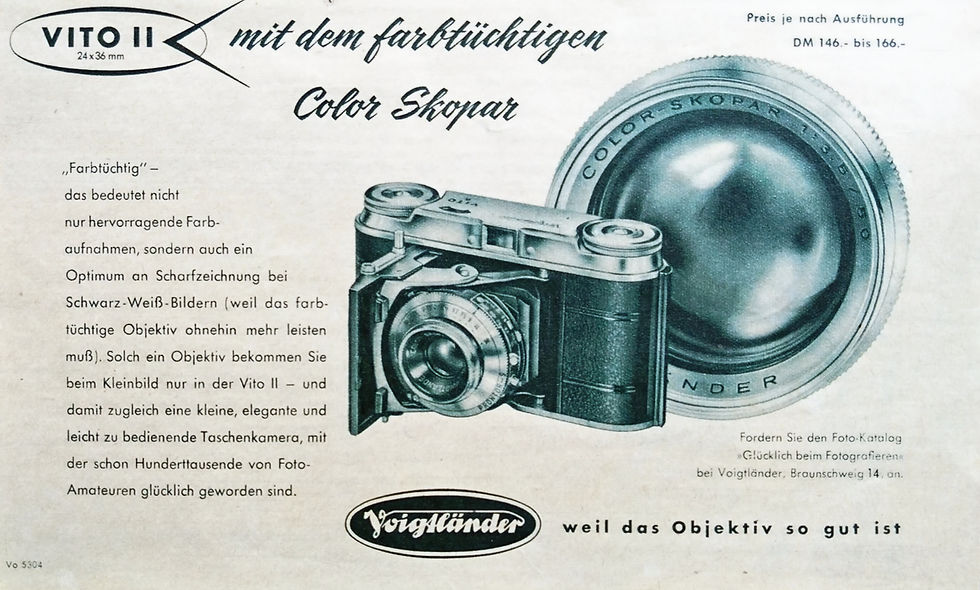
Below are two period German adverts for the Vito II which you may find of interest.

Well I think that is about it for this post, I hope you enjoyed reading it, it was fun to write,
but I realise I have only scratched the surface of the Vito story, so maybe there will be lots more to come? I know that there is lots more still to find out. I do have another Vito or two in my collection so further Vito related posts seem inevitable!
Now, where is my Vito B?
Take care,
Phil



Comments