Agfa Billy Compur-Rapid 4.5 10.5cm Agfa Solinar 6x9 Folding Camera of the late 1930's.
- Kamera Ostalgie

- 5 hours ago
- 7 min read
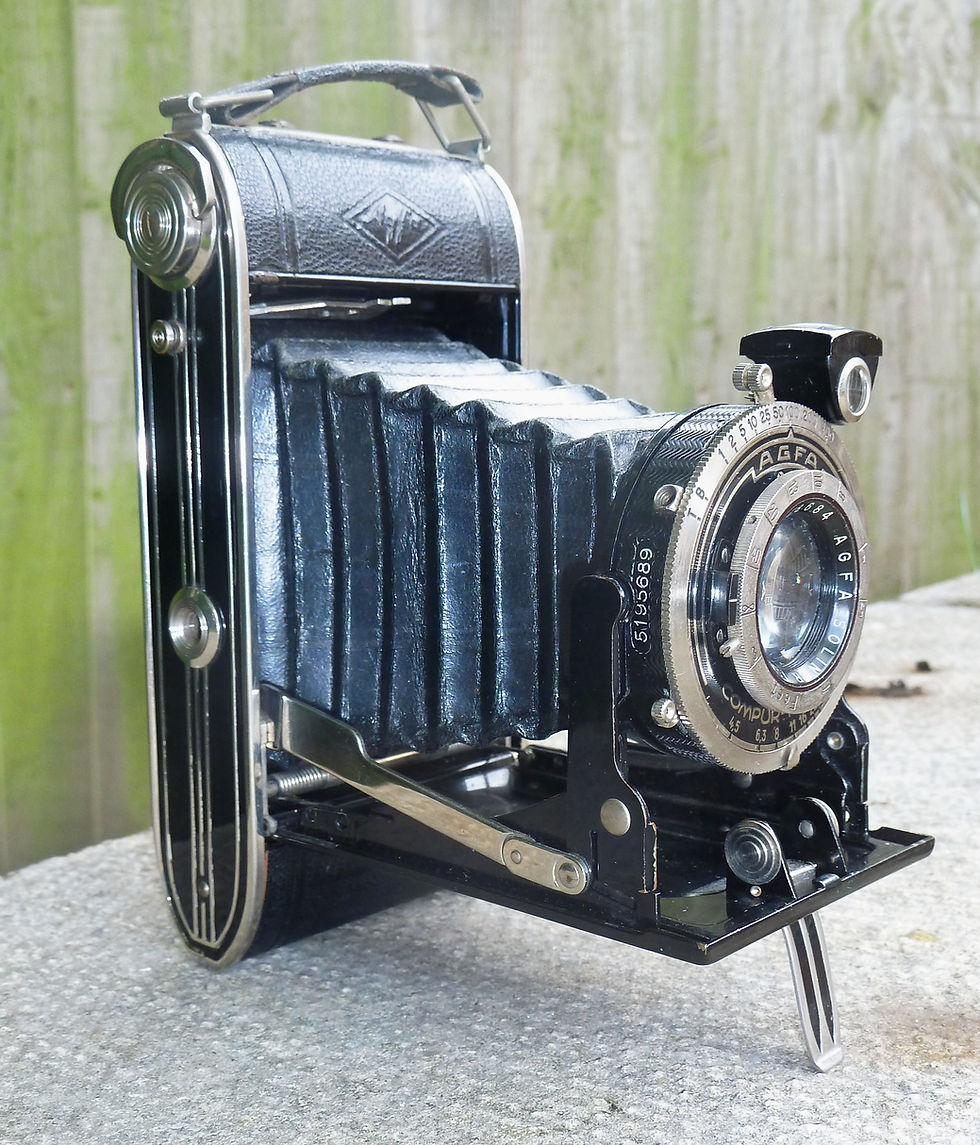
This little beauty above came out of the Agfa Kamerawerke Munchen Germany, sometime in the late 1930's and it is typical of that period with all the Art Deco touches.

I thought I had better redress the balance and write a post on an Agfa Folder instead of the Kodak ones that I seem to have covered lately. The Billy Compur, or in this case the Billy Compur Rapid, was a 6x9cm folding bed, self erecting folding camera taking 8 6x9cm images on Agfa B20 (Kodak 120) film. They were produced from the mid 1930's up until around 1942, when war work halted much of normal camera production.

The camera which is self erecting, is opened by pressing the little button seen here just below the wind on knob on the left of the camera, pictured above. It needs just a little help now to make sure it clicks into position. But that is understandable being around 90years old! To stand the camera up in this position, the lovely well finished foot is lifted out with the fingernail. The foot still springs into the correct position. The sports viewfinder also springs open easily with just a little touch, it's a good finder, easy to look through even with specs.
The Compur-Rapid shutter speed is selected by moving the outer nickel plated ring, so that the required speed lines up with the arrow which sits very neatly between the G and the F in the Agfa logo. So in the picture above the shutter is set to 100th of a second.
This camera is very well speeded, with T and B, then 1, 2, 5, 25, 50, 100, 200, and even 400th of a second. Apertures are equally well catered for with 4.5, 6.3, 8, 11, 16, 22, and f32.
The focus starts at 3 feet, with marks at, 3, 4, 5, 6, 8, 10, 13, 20, 40, and infinity.
The camera has an old style reflex finder as well as the optical sports finder and has tripod bushes positioned so that you can take portraits or landscapes.
The red window has a protective cover so you don't get any light leakage and you know the cover is closed by the white dot in the centre, which reminds you to slide the cover back out of the way when you wind on the film to the next number. A very useful feature in practise.
The Agfa Solinar lens of 10.5cm focal length and f4.5 aperture is numbered 568684. The more you look at this camera the more you start to appreciate its real quality. This must be the nicest 6x9 folder I have ever owned bar none!

This is probably my favourite Agfa camera that I own too. I love the Art Deco styling all the chrome and black lacquer work and the other nice styling touches. But this is not just a pretty camera, yes, it's flash, but check out the lens and shutter combination, a Compur Rapid Shutter and a 10.5cm 4.5 Agfa Solinar lens. This little beauty was built to perform, in no uncertain terms. This Agfa was a serious bit of photographic kit in the late 1930's.

Look at the fastest shutter speed, which is a 400th of a second. That was fast for its time, especially on a folding camera. You don't see many of these Agfa Art Deco Folders with this specification which is a shame.


This are really useable cameras, capable of top quality results by any standards. However, a word of warning, before you all rush out and buy one to use, 99.9% of these pre war Art Deco Agfa Folders will have a seized up focus mechanism, and I mean seized up! The focus, whether it is one with a focus lever or one with the more conventional focusing system, it will be solid and you won't be able to focus the lens at all. They are virtually all like that, unless they have been serviced at some point in the not too distant past. Its not something that warming up with a hair dryer or dropping lighter fuel into it will fix either, this Agfa grease that gums up the focus mechanism, sets like 30 Newton Concrete, rock solid. So if are prepared to spend £100 to get the lens and shutter movements professionally cleaned and re- lubricated then go ahead, it will still be a cheap medium format camera, say thirty pounds for the initial camera purchase and one hundred pounds for the repair, still a good deal, but if you are thinking about spending twenty to thirty pounds on one and expecting to use it think again! You have been warned!

Don't let me put you off though! If you go for a version with the Compur or Compur Rapid Shutter and one of the better lens options like the Solinar or Apotar, then the folding Agfa is worth spending money on to repair, but financially spending a hundred pounds on this style of camera without a good lens shutter combination does not really make sense. On the plus side, the pre war ones usually have much stronger, better quality bellows, these are usually still okay today, unlike the shiny plastic ones on post war versions which look nice and shiny at first inspection, but are always full of pin holes, or if they are okay, they won't be after a couple of films have been put through them and you have opened and closed the camera a few times.

Hopefully if you are still reading this, then the seized focus problem has not put you totally off these fine cameras, so lets have a bit of a closer look.

The open back of the Billy Compur Rapid, 6x9cm frame, good quality pressure plate and a similar film spool holder / loading mechanism to the late 1930's Jsolette.

The pressure plate and the usual nice film transfer telling the user to use Agfa Film B-2, which is Agfa's equivalent to Kodak 120. But not just any B-2 film, no Agfa were recommending Agfa Isopan film and Isochrom film! And why not?

From what I can find out on various internet sources Isopan, which was a black and white panchromatic film, was introduced in around 1935 as a 19 or 20 Din rated film. In around 1937/ 1938 it was revised to 21 DIN. Isochrom an orthochromatic film, was introduced around the same time, 1935, and got a similar speed uprating in 1937.

The film holder is made of alloy and like the Jsolette of the same period has the body numbers stamped on it, in this case 4P 0803. I like the little hinge bit on top of the spool holder, which lifts up to make putting the film in much easier.

A very neat little set up, no struggling to force the film in with this camera, the top of the spool holder just lifts up, and allows you to drop your film in ! That was German
design for you !
I think I have asked this before, but I'll ask again, does anyone understand this code on the spool holders? What actually does 4P 0803 mean?
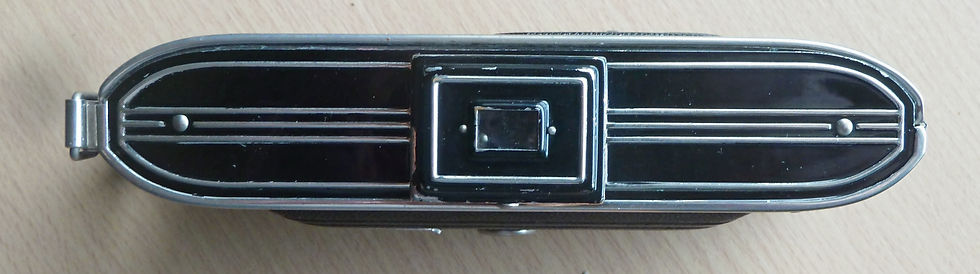
The Billy Compur Rapid and the similar bodied other Art Deco Agfas were neat slim relatively compact cameras as far as 6x9cm folders go. But this neatness or compactness if you prefer, was more noticeable with the Art Deco combination of black lacquer and highly polished plated bodies.

Whatever you may think of 1930's Germany, which lets not beat about the bush, was in effect Nazi Germany, the cameras produced in that time period were second to none, in quality, design, innovation, production methods and actual numbers produced, no other country could get anywhere near Germany as far as camera design and production were concerned.

We tend to forget that in the mid to late 1930's Germany, there was a thriving economy, virtually no unemployment and the German public had really embraced photography. Many quality manufacturers were producing a high volume of cameras and other photographic goods, and Germany was exporting countless cameras throughout the rest of Europe and North America. Germany produced cameras at all price ranges from simple box cameras to the Contax and the Leica.

This particular Agfa was obviously produced for the market of Great Britain, hence the 'Made in Germany' on the black leatherette and the distance in feet not metres, on the lens focussing ring shown below.


The Agfa logo and the detailing on the camera foot are really nice touches, lifting these Art Deco Agfas out of the ordinary. The viewfinder is also finished in a similar way.

The high gloss of the chrome plate and black lacquer are as shiny today as it was when this camera was produced in the late 1930's

With a little digging you can find a fair bit about the Agfa Billy Compur, but as yet I have not managed to find any period data on the Compur Rapid version, though both cameras are of course very similar.

The similar Agfa Billy Record was also well publicised in the 1930's and they are really nice cameras in their own right and you can see the likeness to the Billy Compur and Compur Rapid in the old photographs above.

To conclude our look at the Agfa Billy Compur-Rapid, I think we can safely say it is a interesting high quality camera. The other Art Deco models of the time are also excellent cameras, very collectable and very useable, if you can locate one in first class working order. Collecting just these Art Deco Agfa cameras of the 1930's and 1940's would make a great collection, especially if you could put together a collection in working order so that they could be used as they were intended to be.
Jim Grey in his blog recently was saying that he had to make his mind up whether to keep or let go of a camera. I know where he is coming from. I have a similar problem here, do I keep it as a display item, or get it professionally repaired and put it back into regular use. What do you think, let me know in the comments.

I hope you enjoyed this post,
Phil
Up-date
I've just found these articles on a German Website, which may be of interest to you.
cheers,
Phil


Comments