Collecting Agfa Cameras of the late 1950's early 1960's
- Kamera Ostalgie

- Nov 22, 2025
- 8 min read
Updated: Nov 26, 2025

Of late I have been looking into Agfa cameras made between 1955-1965 in some detail. It started off when I got out my small collection of Agfa cameras from the loft and doing a few posts about them and trying the odd one out. The more I looked into them, the more interesting their history became and the more surprised I was that I had completely overlooked them as a make of camera, when I first started collecting and using old cameras in the late 1970's.

So, why did they get overlooked at the time? I'm not sure, maybe they were just not old enough to spark my interest then, maybe it was just because there were so many of them around in second hand shops, cameras fairs and charity shops. Whatever the reason lets make up for that now and have a proper good look at them.
I suppose the two main model lines were the Silettes and the Optimas which in the late 1950's early 1960's shared a similar main body style. So in this post, lets focus on them.

The bulk, though not all of the Silettes and Optimas of that period shared the basic body pictured above. The top plates and all other features differed, but this bottom style of body was common to most models

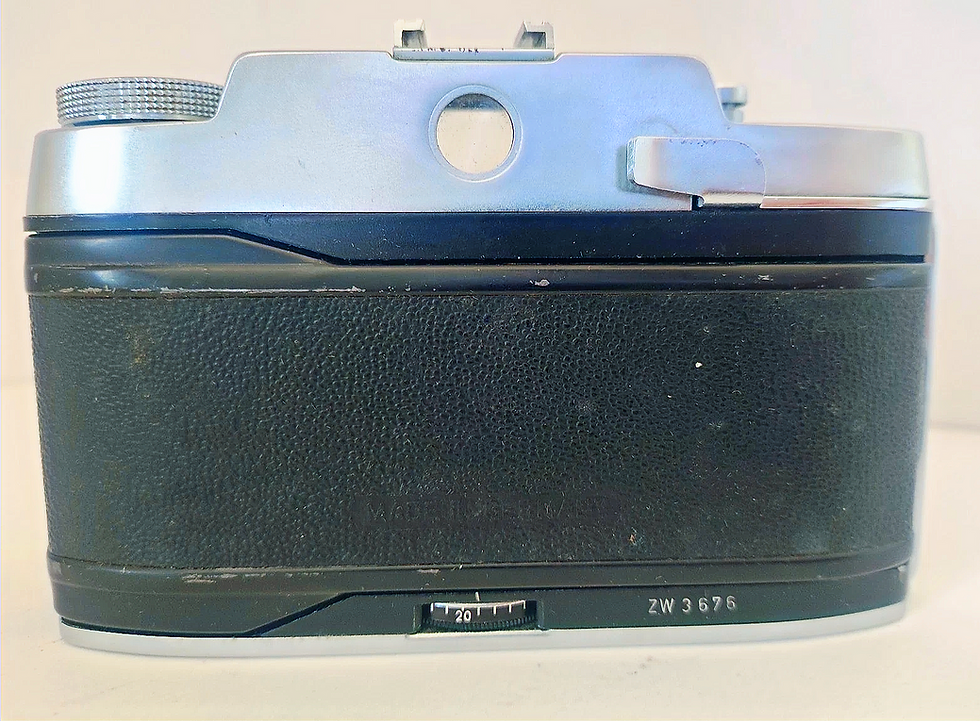
.
So as you can see from the pictures above, the main body was basically the same, whether it was an Optima, a Silette, or a Super Silette. So lets have a look and see what different models they produced using this style of body. Luckily one of Kamera Ostalgies members kindly copied some period Agfa Catalogues, so we can see exactly just what was being produced at this time, as well as providing excellent pictures of some of the Agfa's that I do not own. I suppose the main period where Agfa used this body was 1958-1963, after that the next phase of cameras with more engineering plastics being used, was gradually phased in.
Silette Vario - At £9.18.6 this was the entry level Silette with the Vario three speed shutter and the Color-Agnar f3.5, 45mm lens. Ref 2100.

Silette Brightline 4-speed.- At £15.17.8 you got a Silette with a 4 speed Vario shutter and a faster f2.8 45mm Color Agnar lens. Ref 2101.
Silette Brightline 9 Speed - At £21.0.9 this Silette came with the Color-Apotar f2.8, 45mm lens with a 9 Speed Prontor SVS shutter. Ref 2102.
Solette Solinar Brightline - At £ 24.14.2 this Silette had to be a bargain, with the superb Color Solinar 4 element lens, 10 speed Compur-Rapid shutter, Ref 2104.
Super Silette L - Price not known. Lens is the up market 50mm f2.8 Color-Solinar with a Syncro-Compur shutter and a rangefinder. No bright line finder on this model. Not many of this particular Silette seemed to get to Great Britain, but more common in Germany, Austria, Canada & the USA. Ref 2105.

Silette L - £ 26.11.3 The Silette with a built in light meter. Back to a 4 Speed Pronto shutter and the Color Apotar f2.8 45mm lens. Ref 2106.
Silette LK - £ 32.11.0 This model has a coupled built in light meter. Color-Apotar lens f2.8 of 45mm, with a Protor LK 5 speed shutter. Ref 2108.
Super Silette - £ 31.11.6 Coupled Rangefinder, 10 speed Prontor SVS shutter, Color Apotar f 2.8 45mm lens. Ref 2107.

Super Silette LK - £39.9.8 Coupled Rangefinder, coupled light meter, Pronto LK 6 speed shutter, Color-Apotar f2.8 45mm lens. Ref 2110.

Super Silette Automatic - £50.17.2 Top of the range, with coupled rangefinder, coupled light meter, Color-Solinar f 2.8 50mm 4 element lens, 9 speed Prontor SLK shutter. Ref 2120.


So that is roughly the list of Silette based models of the very late 1950's to very early 1960's, I'm sure there will be the odd variation that I've missed and some minor sub variations,
but before we look at the very similar Optima and try and list them in a similar fashion, lets take a look at this camera, the Agfa Selecta, its neither a Optima or a Silette, yet it's both !

Selecta - £ 46.5.7, Agfa Color-Apotar f2.8, 45mm with Prontor-Matic P shutter. Automatic camera. This camera I rather like the look of, so it's on my shopping list! Ref 2204.
Optima - £ 39.2.3 Colour-Apotar lens f3.9 39mm with a Compur shutter arrangement. Agfa's fully automatic camera of 1959. The lens max aperture of 3.9 and the focal length of 39mm are a little unusual, plus the fact that neither are stated on the lens as is normal practise. Ref 2200

Optima I - £ 31.19.8 Color-Agnar lens, with a Protor-Lux shutter. Another fully Automatic camera with three zone symbol focussing. Ref 2207.
Optima II - £ 42.10.8 Color-Apotar lens of f2.8, 45mm in a Prontomator shutter. Again fully automatic, with three zone symbol focussing. Ref 2210.

Optima IIS - Not sold in Great Britain. Color-Apotar lens of f2.8, 45mm, in a Prontomator shutter, but with the very useful addition of a coupled rangefinder. USA / Canada market.

Optima III - £53.5.2 Color-Apotar lens of f2.8 45mm in a Compur Special shutter. Focus reverts back to the three zone symbol system. Ref 2201

Optima IIIS - £63.19.4 Color-Apotar lens of f2.8 45mm in a Compur Special shutter. The IIIS also has the coupled rangefinder of the IIS making it a very special camera. Another one for the shopping list. Ref 2202

Optima 500 S - Very similar specification to the Optima III S, but with the 500 S you get the top of the range Agfa Color-Solinar as well. This has to be the ultimate Optima. Ref 2300
So that is more or less it in the Silette / Optima range of the late 1950's early 1960's apart from the other Selecta, which we better just mention to avoid any confusion, the Selecta -m-. This was a camera developed by Iloca in Germany, but Iloca got into financial difficulties and were bought out by Agfa. The Agfa Selecta m is really an Iloca design, it should not be confused with the Agfa Selecta 2204 which is a totally different camera.

But it is a very nice looking camera if somewhat hard to find and expensive if you find one !
Selecta -m- £ 99.19.6 motor driven film transport, fully automatic with selective automation, coupled rangefinder, top quality Solinar lens. Ref 2204.
So, why do I think collecting Agfa cameras from this time period is a good idea? Well there are a few reasons, the first being that currently there are not that many camera collectors interested in them! That is always a good start, it keeps prices sensible, with low demand and no hyped up bullshit. However having said that, there are always people looking for the rarer or top specification models, even with Agfa cameras. Anything unusual like the Super Silette Automatic which I have just been out bid on as I write, or either of the Selctas or Optima IIS / III/S will always spark some interest.

Next, there is a good variety of models available, and in good numbers, so you can pick and
choose, getting the best example going. If you miss buying one for some reason another better one will pop up online very soon. There are only a handful of models that are less common.
Even the low cost basic Agfa cameras are well made and capable of good results. So a Silette Vario for example which you may obtain for around £10, will be worth trying out with film. I'm sure the lower cost Agfa cameras were loss leaders just to get customers into Agfa cameras and of course using Agfa films & papers, where the real profits were made. So don't get put off by the more basic or common versions, if they are in workable order to start with, they will produce good results, all of them, even the basic entry level Silette.

If you are planning on using your old Agfa, then it is well worth getting a good lens hood for it. They cut out the stray light coming in from the side and offer your lens some degree of protection, and your images will look a lot better because of it. On top of that, if you get a nice original alloy one, they polish up fantastic with some Autosol chrome cleaner and your £10 Sillette will look a million dollars with a highly polished lens hood on it. The earlier and more basic models tend to be 30mm thread, whilst some of the others are 35.5mm, so you need to check. You could use a push fit type, but they are easy to loose. Top tip, don't just buy a lens hood on its own, you will pay more for it than if you look for another Agfa of the same type online that comes with a lens hood anyway. That way you get two cameras and can share the lens hood for the same money.
Whilst you are at it, buy a selection of filters, it all makes for better results! Again don't just buy separate filters, look out for a camera for sale with a filter or filters. Agfa made their own filters and there were also good aftermarket filters made at the time, in Germany and Great Britain.

Two other things that would make life easier if you are going to use your classic Agfa, is a separate rangefinder that you can just pop onto the accessory shoe and transfer the reading from your rangefinder to your lens and also maybe a light meter. Agfa made two really nice light meters at this time, both seem to have aged well, so you can still buy them in working order. They are the Lucimat, Ref 6381 at £10.9.3 or the Lucimeter S, Ref 6380 at £7.9.0. Of course if you have a higher spec Agfa you may have one or both these features built in.

Also remember these cameras are sixty or so years old, if you are considering one to use on a regular basis, then it would be prudent to get the shutter serviced and the glass cleaned. If you are just going to use them occasionally or they are going to be for a visual display then this is not needed. Remember to budget for a service, the cost will be far greater than the initial purchase of the camera I'm afraid, but with an accurate shutter and a clean lens the resulting images will be of a much greater quality and you will enjoy your camera and not become frustrated with it, or waste expensive film. The thing to do would be get your favourite Agfa serviced and use that for your regular photography, any further ones could be serviced when finances allow.

So I hope you enjoyed this quick look at some of the Agfa cameras of the late 1950's and early 1960's. In my humble opinion this was the best era for 35mm Agfa cameras. The level of innovation was high and the quality was also high. I think today, they are highly collectable, lots of models to choose from and still currently quite reasonable in price. So, if you are wanting a change, or looking for something 'new' to collect take a look at some Agfas! If you are really keen there are even more models to search out. But for me that is for another day & maybe another post!
Happy Collecting!
Take care,
Phil


Comments