K.W. Praktica FX
- Kamera Ostalgie

- Jan 5
- 7 min read
Updated: Jan 11
We all know about the Kine Exakta being the first 35mm SLR camera out of Dresden, but most photographic history records don't really tell us about the second 35mm S.L.R. I suppose modern society focuses on the first, the winner, but coming second is not really winning, so gets lost in history. Who or what was the second 35mm SLR out of the great city of Dresden? It was K.W's Praktiflex! Maybe not the first, but it could be argued that it was the more important design. Either way, the Ihagee Kine Exakta and the Dresdener Kamera-Werken Praktiflex were to my mind, the most important designs to appear out of Dresden in the late 1930's.

After the Praktiflex came the original Praktica, then the Praktica FX which is the camera I have sat in front of me now, on my desk.

An original Praktica advert of the period.

The Praktiflex had a lens mount of M40, but by the time this Praktica arrived on the scene the mount was M42. People tend to call the M42 mount, the Pentax mount, but no, the M42 mount was pure Dresden not Japan. It is the Praktica mount. Others copied, but K.W. were first, along with the original Dresden Zeiss Ikon Pentacon F/ Contax D SLR, the M42 mount originated in Dresden Germany! Both the Praktica and the Pentacon/Contax were landmark designs along with the Exakta and all were out of the 1950's camera capital of the world Dresden.

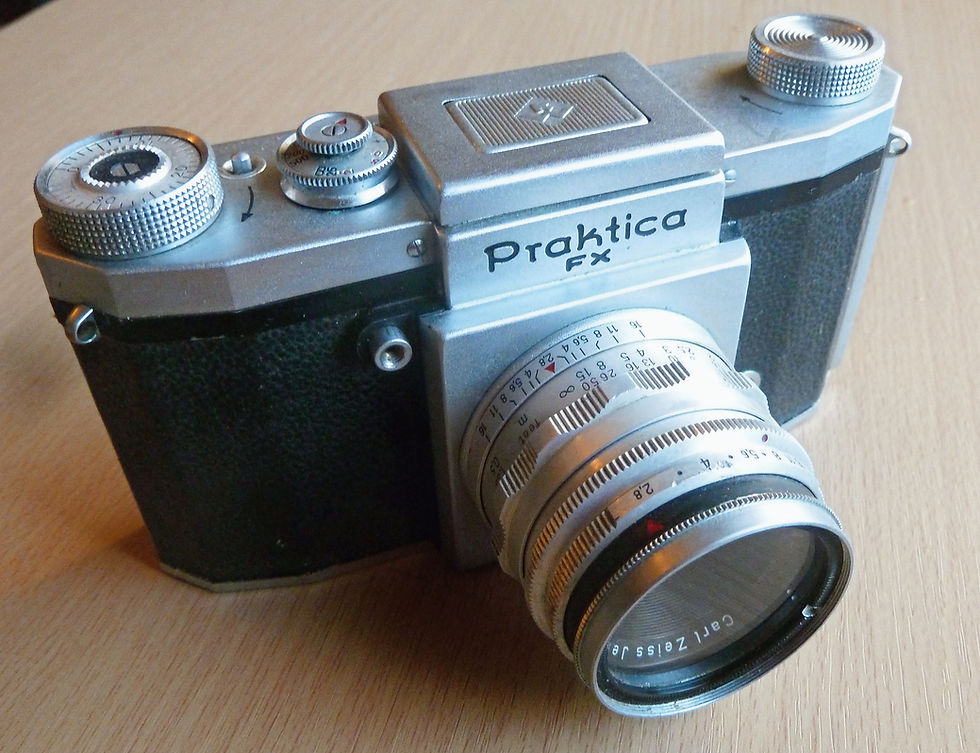
This Praktica FX is the earliest Praktica I currently have, dating from the mid 1950's. Most likely from 1954 I think. It has the body number 206186 and came with a Carl Zeiss Jena 50mm Tessar 2.8 Red T lens, numbered 4313844.

The camera looks to have had quite a bit of use over the years, it was bought with a non working shutter, which now operates but is probably inaccurate and could do with a professional service before being put into regular use. It currently sounds like an old wheezing asthmatic who has just run a marathon.

The waist level finder has this neat little magnifying glass attached, that you can flick up if needed for critical focus. It is difficult to focus, there is no doubt about that, but there is a fair bit of dust and debris that have accumulated over the last 70 years that don't help! So a dismantle and clean will be on the cards there. But to be fair it is no worse than the similar waist level finder of the contemporary Exa and Exakta.

There is a solution or two if you can't cope with the waist level finder..................................

..................... Carl Zeiss Jena made a prism for it !!! Ace. These are mentioned in Roger Rossings Praktica book, it looks like you sent your Praktica FX back to the factory to get this fitted. It must have been a big improvement, but at a great cost, I have heard that at the time your Praktica fitted with the Prism would cost you more than the more versatile Exakta with a Prism! But if you preferred the Praktica set up, and many did, it was a great option. There was another choice however.

Carl Zeiss Jena also produced a Prism that just attached to your waist level finder Praktica as on the picture above. It looks a bit like it is just perched on to of the camera, making the camera look very tall, but I would still love to try one out.
These prisms are best seen on the links below
All at my favourite Praktica site Praktica-Collector.de, well worth a look.
Lots of Praktica information for you on this site, though I don't think it is still active as such.
Also there was a similar Prism made by the German accessory maker Sperling, called the Hasp? Though I have never seen one myself, only in pictures. I have found very little out about the Prism or indeed the manufacturer, I'm afraid, apart from a few pictures.


By the wear on the waist level finder on my example,( see picture above) it looks like one of the attachable Prisms was used a lot on this camera at some point in its long life.

The lens on my example is the faster of the two Tessars available for the Praktica FX, the 50mm 2.8 Tessar, there was also the 50mm 3.5 Tessar as a slightly cheaper option. If you were looking for a better lens still and you had the cash, then the Carl Zeiss f2 Biotar would have been your lens of choice. It would however have cost you over 100 DM more than the Tessar in early 1950's Germany. A lot of money just after the war and in an economy held back by the occupying Soviet / Russian forces. But what a photographic tool that would have made.

There were quite a few different versions of these Praktica FX cameras.
Today on the internet various sources give the different versions and orders in which they appeared. However few of these modern day sources agree with each other, so in the interest of trying to be as factual as I can, I'm going with the different variations mentioned in Roger Rossings book. After all, he was there at the time, his book was actually written at that time they were in production and he was very well connected with the people at K.W. and the photographic scene as a whole in the post war G.D.R.
First was the forerunner of the Praktica, the Praktiflex. It can be recognised by the nameplate saying Praktiflex, rather than Praktica, it also had a lack of slow speeds, just 1/25th then B and it had a different lens thread of M40 rather than M42.
The first Praktica just had Praktica on the nameplate, it came with a range of slow speeds and the newly introduced M42 lens mount thread. There was no FX underneath the nameplate.
Then came the Praktica FX. the first type had the flash contacts hidden away on the underside of the camera, no flash sockets on the camera front.
This seemed to be a short lived version, as soon the FX sported three flash sockets on the front of the camera body. The top one was X, the middle one Earth and the bottom one F.
The next variation had just two flash sockets on the front of the body, not three. The top one X, the lower one earth.
Finally, and this is the version I have, there is just the X socket on the front of the camera body. Just to confuse things, this can be found at two different heights on the body front! See picture on instruction book below.

Of course you have to be careful as flash sockets could and were altered when the camera went back to the makers for service or up-grade, and of course they could be altered or added by independent repair shops too. But that is a list of the different variations as observed at the time. Modern day collectors tend to look for different production variations and make up rare models retrospectively, I'm keeping it simple.

So let us have a closer look at the Praktica FX we have here. The camera is reasonably heavy weighing in at 730g. To wind the film on and charge the shutter you turn the large knob on the far right in a clockwise direction as indicated by the large black arrow. This charges the shutter and lowers the mirror so that you can see your image. The fast shutter speeds are 25th, 50th, 100th, 200th and 500th of a second. The sow range are 10th, 5th and half a second, with of course B.

The dual shutter speed control can be a bit off putting if you are not used to the set up, but it is easy enough really. In the picture above, the shutter is set at 100th of a second. How can we tell, well the top red arrow is pointing to the bottom black arrow, so we are on the fast speed range, and the little red dot is opposite the 100. So for all fast speeds the top red arrow is opposite the bottom black one. Then you just select which fast speed you need using the red dot. If you wanted to use the slow speeds, then set the top red arrow opposite the bottom red arrow and place the little red dot opposite the slow speed that you require. The slow speeds are in red, the fast speeds are in black. A little tip, when you fire the shutter don't go over the top of the camera to get to the shutter with your finger as you will obstruct the speed knobs which turn as the shutter fires and your finger will slow the shutter! Go round the camera body with your finger to reach the shutter, that way it will not catch the moving speed dial.

Talking of tips, remember when loading the film on a lot of the early Prakticas, the camera back may look like it is hinged, but they are not! So make sure you hold the camera back as you open it, in so doing you will stop the camera back ending upon the floor.


Well I think that more or less sums up the Praktica FX. They are great looking cameras and often overlooked both in history and still today. But at the time in the early to mid 1950's these little Prakticas were a milestone camera.
Think about it, you are a keen photographer in post war Europe, you are wanting a new 35mm minature camera. Just what was available to you that was any good? Not that much really. Well you had the Leica of course and the Contax, but they were rangefinders, old hat and too expensive, you wanted new tech, which meant an SLR, so your choice was the Pentacon / Contax family of SLR's, the Exakta / Exa range from Ihagee, or the K.W. Praktica. Well the Pentacon / Contax were nice but too expensive, the Exakta was again very nice but again too expensive, the Exa was cheaper, but you wanted faster shutter speeds and to be able to use lenses of greater length than 100mm, so that was out, what had you left that was good, but affordable, yes the Praktica FX, the best choice for the serious amateur photographer who was not rich but wanted quality results in the 1950's. There was no other contender!

This book is a must if you are using and collecting Vintage Prakticas.


Is this still true in 2026? Seventy or so years on?
The Praktica FX family of cameras, the best German 1950's vintage 35mm cameras to use in 2026?
They could be!
Try one!
Take care,
Phil
You also may like reading these older posts on the similar Praktica III and the Praktica IV.


Comments