Voigtlander Vitessa, a futuristic 35mm rangefinder camera of the 1950's.


I started this post a year or so ago, finished it in April, but was never 100% happy defining things, as all sources historic and contemporary contradicted each other on model names specs, everything. German sources had different info to British and American sources, it was a nightmare to compile and know that you were 100% accurate on everything. So it got culled time and time again, in the end I did not use it. But as the blog is ending in two days time, and there is a lot of useful information in the post, then I have decided to put this very much shortened version out, hopefully it may be of interest to someone!
Introduced in around 1950 the Voigtlander Vitessa was produced in various models until around 1957/58.
The number of models can be quite confusing, I've done a lot of digging since deciding to do a post on my Fathers olds Vitessa and it is mind blowing in the extreme, with modern day collectors giving them a series of letters and even letters followed by numbers denoting models and sub models. However these are not the factory names or models, just hyped up latter day model names which maybe were designed to simplify things but in reality just made things confusing. I personally think this is all you need to know :-
Vitessa (Type 125) The original late 1950 version. ( some sources say not available in Germany until 1953.)
Vitessa (Type 132) 1952-53. Colour Skopar available. Now with removeable back.
Vitessa (Type 133) 1954
Vitessa (Type 134) 1954 Permanently fixed accessory shoe.
Vitessa (Type 136) 1956 Model T with solid front.
Vitessa (Type 140) 1954 Model L with built in light meter.

The letters A and N were not used by Voigtlander, they are modern collector made up names, only T and L are factory names. So in this article, as I'm from Yorkshire where we call a spade a spade, we will cut the bullshit and A and N and their following numbers will not be used. Lets just accept there are going to be differences and changes in a long model production run, but they are just that, changes, alterations and differences, nothing more and certainly not different models. They are cameras designed to take pictures, nothing more nothing less!

Don't get me wrong, I find the variations very interesting, and the reasons why the factory made those alterations even more interesting, I like looking for variations and differences, but this 'oh it's a different model' culture I hate, it's just a modern day vehicle for camera dealers to hike up prices, that is all.
Lets look at a period advert just to illustrate the point !

It's just the Voigtlander Vitessa, no A or N mentioned! Just a later Vitessa with the accessory shoe, and in the advert below an early Vitessa with no shoe.

Now if we look at an original advert for the Voigtlander Vitessa L from 1954, then we se that Voigtlander uses the L in their adverts for the metered Vitessa.

The same goes for the solid bodied Vitessa T. The advert shows that Voigtlander used the T as its official name. So in my mind the correct way of naming the cameras is with whatever they were named with by the factory. Other differences between cameras of the same model are just differences not another model. I know many people will not agree, and giving them false modern names may make it easier for modern day collectors, but that's all it is, a thing to make identifying differences in a particular model easy for collectors, its not original history. The trouble is with this way of doing, people use 'A' and 'N' as if they were original factory names, and they are not.

Right, lets get to the camera in question, the new Vitessa Type 125 of late 1950, and the best way to start is to look at a page from a Voigtlander brochure printed at the time the camera was released.

If you want to read up on the multitude of production variations on the Vitessa then have a look at this German site here, it goes into every little detail in great detail! But is really worth the read.
However this site also says both the Type 134 and Type 140 both have light meters!
All other reference sites that I have read,( and I have spent days and days double checking,) say just the Type 140 has a light meter. Everything written about these cameras both at the time and more recently seem to contradict each other, so much so that I'm just sick of wasting time trying to establish the facts! So lets call it a day, make up your own minds about it all, but for me trying to sort out what is fact and what is fiction is a road I'm no longer going down, lets just enjoy the Vitessa for what it is, a high quality useable camera capable of providing first class results even today. Whatever the type the variation, they were excellent cameras, every one of them.
The concept of the Vitessa was brilliant, a compact modern streamlined 35mm camera, complete with coupled rangefinder where the rangefinder could be seen through the viewfinder window, and the quick action where after firing the shutter, the camera wound on the film primed the shutter and counted the exposure in on operation, namely pressing the plunger ! A brilliant design. This was backed up by fitting it with a high quality lens, in this case on the early Vitessas was the f:2 50mm Ultron in a equally high quality shutter, the Compur Rapid Shutter. What makes this camera even more remarkable was that all this came about less than 5 years after the devastation left by World War Two. Remarkable, whatever way you look at it.

I personally prefer the look of these earlier Vitessas, with the clean top plate, no accessory shoe, no light meter etc. The later ones are said to be of even better build quality and with a shoe and or a meter may be more versatile in use, but the early Type 125's are much cleaner less cluttered and atheistically much better.
The viewfinder on these models have the manually adjusted parallax correction where you just slide the viewfinder in the required position either close up or infinity.
I have to thank one of Kamera Ostlagies subscribers in providing photographs of the Vitessa models that I do not own, also providing me with much detailed information that I was not fully aware of, which has made this post far more complete.

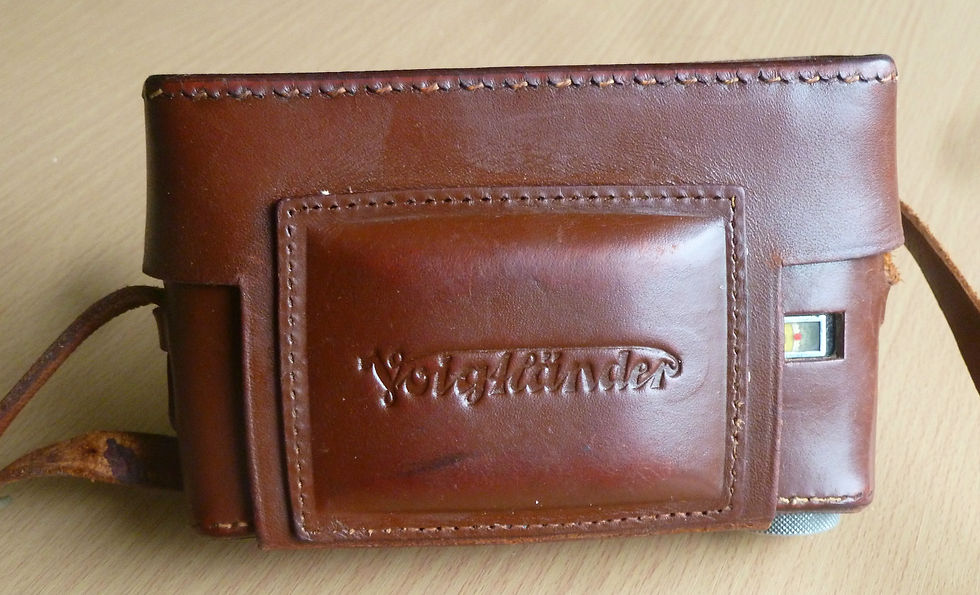
My late father had a couple of Vitessas, one he bought nearly new at the time, this is the camera pictured at the start of this post, one a little later, he told me that the Ultron lens was as good as, or better than the Leica lenses of the time. This was not an idle comment, my Father bought his first Leica shortly after the war and often used Leica's both screw and M throughout his life and used them very frequently. I often wondered if he was right in his opinion, so lets see if we can find anything out today regarding it.
I have researched it conventionally and with, shock horror, the help of AI ! Both methods come up with more or less the same conclusions, but for convenience and use of space lets see how AI summed it up !
Comparison to Leica Lenses
Image Quality:
Benchmarked against the 50mm f/2 Summitar or the early Summicron, the Ultron f/2 performed exceptionally well, even at maximum aperture, capturing sharp and contrasty images with minimal distortion. Contemporary reports cite it as slightly preferable in terms of overall resolution and tonal rendering.
Summary
The Voigtländer Ultron 50mm f/2 on the Vitessa:
Was technically on par with Leica 50mm f/2 lenses of the early 1950s in image quality.

Well, that was a surprise that the conclusion was the same, I had no doubt that he was right, just surprised that today AI came up with the same conclusion. So lets have a little dig into the fabulous Ultron lens.
The Ultron lens was designed by a gentleman called Mr A.W Tronnier, now that name may not be familiar to you, but Mr Albrecht Wilhelm Tronnier was the genius who was behind the design of the Schneider-Kreuznach Xenon and Xenon lenses which were popular quality lenses in the 1930's ! No wonder the Ultron lens was such a quality piece of glass. He was also behind some of Voigtlanders other quality lenses, the Color-Skopar, Color-Heliar and the Nokton lens. Quite a collection!
The Ultron lens was a Double Gauss design of 6 elements. The original Double Gauss design was patented way back in 1888 by Alvan Graham Clark. In practise it was a well corrected lens of high contrast and good tonal separation, contempory reports say that it matched or exceeded the performance of the Leitz f:2 Summitar of the same period! So to sum up, in the 1950's you could nor get much better than the f: Ultron.
Some period reports, and some contemporary blog posts mention the lens is prone to flair, but as Voigtlander produced a really nice lens hood for it with the code 125/20 the use of this hood should greatly reduce the problem if not eliminate it altogether.

Soon the Vitessa was available with the Color Skopar lens, which made the camera slightly cheaper and more affordable. There was not much drop of in lens quality as the f:3.5 Color-Skopar, a four element lens of the Tessar type was still an exceptional lens in its day.
Later, some Vitessas had the f 2.8 Colour Skopar as well. Another excellent lens.
I hope you find this abridged post of some interest.
I'm still waiting to get my Praktica B200 film back, hopefully I can get the results out to you in time before the blog ends. One point I can share now, the B 200 still eats batteries for breakfast ! This new battery lasted around 10 days. The only option is to take out the battery as soon as you stop using the camera, which is a bit of a pain, the rest of the camera is really great to use!
Take care,
Phil


Comments