Voigtlander Vito B
- Kamera Ostalgie

- Mar 9
- 7 min read
Updated: Mar 11

The Voigtlander Vito B was introduced in 1954. It is one of my favourite cameras, somehow it just oozes quality, feels right and produces great results. The chrome body finish is superb and has withstood the test of time much better than all its rivals, if looked after it will look as good as it did Seventy years ago, the chrome still shiny, not dull or pitted. The quality of most 1950's Voigtlanders was high, but the Vito B was in a league of its own. Some people used to call it the poor mans Leica, I think it was the sensible mans Leica, camera quality and the images produced with it were excellent. If you wanted a Leica but did not have the money or want to feel so ostentatious, with a Leica IIIg hanging around your neck, then the Vito B gave you the feel of one and comparable results, for a lot less money.

I can best explain it with this 1950's car comparison. If you wanted to buy a Rolls Royce in the 1950's but did not want to spend all that money or be so ostentatious then you would have bought a Rover P4, very similar feel and quality, but for a lot less cash. The Vito B has the same feel of quality as a Rover P4.

I bought this Vito B back in the 1980's as a young man, it would then have been about thirty years old when I bought it. I could not believe even then that I could buy such a good quality camera for what I paid for it. I had a Leica IIIB at the time, but ended up putting a lot more films through the Vito B than I did the Leica! It's only let down was the lack of a rangefinder, but I just sat an accessory rangefinder on the top shoe and that was it. If you forgot the rangefinder, or did not have one, Voigtlander conveniently placed a little triangle on the focus ring between the 9 feet mark and the 12 feet mark. If you set your focus to this little triangle and you have the aperture at f5.6 or smaller, then the image will be acceptably sharp between 8 or 18 feet or so.

Between 20 feet and 60 feet on the focussing scale Voigtlander kindly placed a little circle, so if you set the focus to the little circle, then your image will be acceptably sharp between about 15 feet and infinity, providing your aperture is f 5.6 or smaller, i.e f8, f11, f16 or f22. I suppose you could call this use of the triangle and circle a snapshot mode.

In practise what I did was have a 100 ASA film in, have the shutter set at 125, the aperture at f16 and the focus set at the little circle, then the Vito was ready for action, just compose and fire, then you were not going to miss your shot, if you then had more time you could focus correctly and use your light meter, but at least you would not have missed your shot. If it was not as sunny then set the aperture at f11. Seat of the pants stuff maybe but it works. If you have the time then yes make full use of a light meter and rangefinder, but at least the Vito gives you another option.

Depending what sort of film I was using, I had two different options of what to mount on the cold shoe. If I was taking colour slides with the Vito, I had a Kodalux L Light meter sat on the shoe, as exposure was more critical and I could guess the distance. If I was using Black and White or Colour Print film, I had the rangefinder on the shoe, as I could guess the exposure easier as there was much more latitude with the print films than reversal film. I hope you get my drift!

The Vito B was advertised widely all over Europe an in the USA as well as in its native Germany, see images below.


It was very successful and Voigtlander must have made and sold lots of these fantastic cameras between 1954 and 1959. Lets have a closer look.
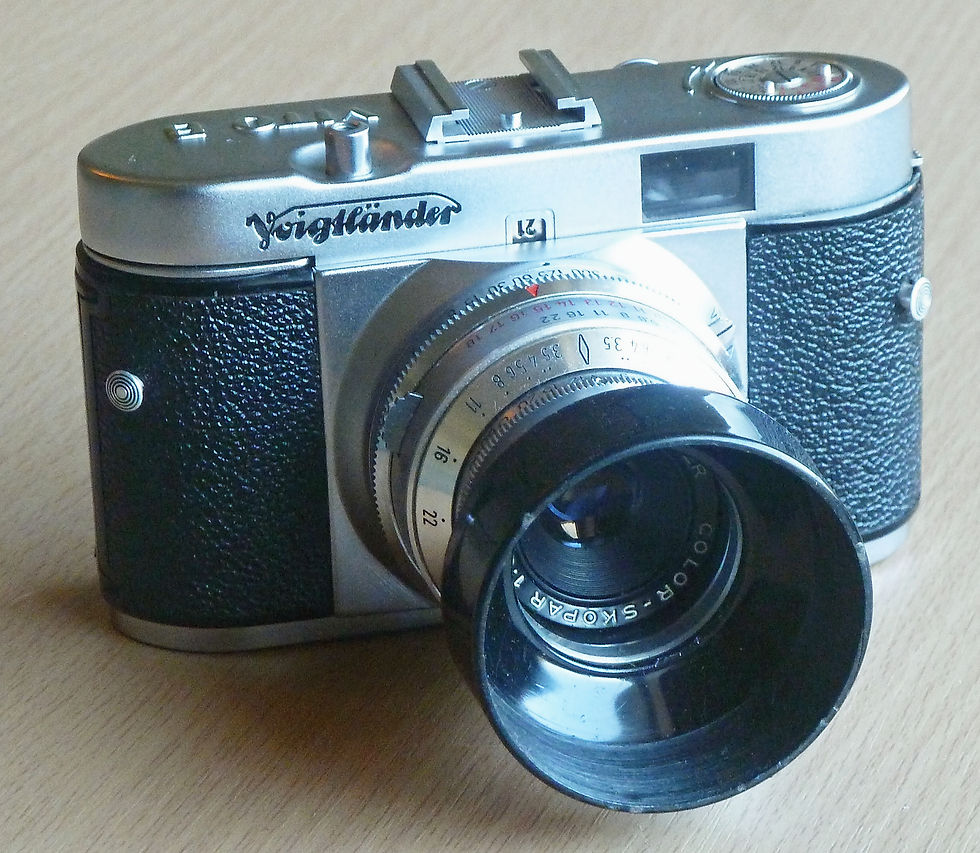
My particular examples is one of the earlier ones, it has the Pronto SVS shutter with speeds of 300, 125, 60, 30, 15, 8, 4, 2, 1, and B. The lens is an f3.5 50mmn Color-Skopar. There was a version with a simpler 4 speed Pronto shutter as well. Later examples also had a 2.8 Color-Skopar and there was a taller version from 1957 with a much larger viewfinder, but whilst it was easier to frame your image, the camera lost its neat look with that taller body. All three versions were fantastic cameras capable of outstanding results, which ever one you may own. Some sources say that production of the first versions stopped when the tall bodied type came out in 1957, others say both versions continued to the end of production, which was either 1959 or 1960 depending on your source.

One of my favourite features of the Vito B is the ease of loading a film into it with the neat little 'door' which drops down so you can easily load your film.

I mean just look at the room you have here to pop your film into the Vito B. Compare that with a Leica IIIg................................well there just is no comparison to my mind.

Voigtlander made a lot of this feature and the resulting ease of loading in their advertising of the time.

I'm not surprised that there was a long delay in getting your Vito B when new, as mentioned in the advert above, the price was fantastic for the quality that you got, they must have sold like hot cakes! I know you did not have a built in range finder or interchangeable lenses on the Vito, but that aside, if you used an accessory range finder on the cold shoe, the resulting images would be indistinguishable from those images using a IIIg.

If you wanted to have a high quality camera in the 1950's the Vito B was the one to get, this still remains the same in 2026, for a fraction of the price of a vintage Leica, the Vito will perform and get you fantastic results today.
To help you get good results from your Vito B always get a lens hood it really helps on most old cameras, not just the Vito. The size on my example is 32mm of the push on variety. This one on my Vito B is not a Voigtlander one, it is made of black Bakelite or plastic, there is no makers name on the hood or on the leather case it lives in, but it is well made and a good fit!

The cases for the lens hoods are designed to fit on the strap of your cameras case, so once purchased and fitted onto your strap
you will always have it with you.

I know that may be obvious to most old timers, but if you are new to vintage film photography then it may not be the case, no pun intended!
Accessory rangefinders and light meters can be bought and carried in the same manner on the camera case strap.
Of course if you are a purest then you can fit a genuine Voigtlander Vito B lens hood. They were available in black too, and in polished alloy, but they may in this crazy world, cost you more than an actual working Vito B! I know, it is bonkers, but they do look nice ! Don't worry, a un branded one will work and fit just as well.

The Voigtlander code for the lens hood is 310/32.


It is really nice to have one with the 'V' on it, but like I said it may cost you more than the Vito B. If you are really lucky you can of course find one for sale with the camera. This is the most economical option.
Filters are 32mm push on fit too.

Range finders are another useful tool for getting the best out of your Vito B. Again original Voigtlander versions can be expensive, however non Voigtlander versions fit and work just as well. try and get one with the little leather case then it can be attached to the camera case strap and you will never be without it.

Take your time if you are wanting a genuine one, some people are asking £70 plus which is far too much, keep looking, £25 is much more sensible for these. In Germany some dealers are asking over 150 Euros for them! Madness.

Even better is to see if an outfit comes up with lens hood, filters and rangefinder all together, you will get it much cheaper as an outfit than buying individual items.

Just remember, whatever rangefinder you buy make sure you get the correct version in feet or metres whatever your Vito has engraved on its lens mount! The codes for the Voigtlander ones are 93/184 and 90/084, not sure why there are different codes. I'm sure one of you will tell me!

So remember, before you splash out on the rangefinder, check to see if your particular Vito is in feet, or meters. This example above clearly states that it is feet!
Okay, enough on the accessories, lets get back to the Vito B. One of the many nice features of the Vito B is the pop up re-wind knob, as illustrated below.

This is a really nice feature, much better than many of its contemporaries, plus it has more feel when winding the film back, you will know definitely with this that you have re wound the film.

This is the location of the little lever you use for the re wind knob. You just move it back towards you and the re wind knob pops up. The engineering on these Vitos is fantastic.

It also doubles up as a film type reminder! The Voigtlander designers in the 1950's were really at the top of their game, as was the quality of the engineering and finish. Leica must have been worried.

They sold well in the U.S.A too, see the advert below.

$45.50 dollars in 1955, can any of my American readers say if that was good value or not at the time? The advert makes it sound that way!
There are as previously mentioned other versions of the Vito B, also there is the rare rangefinder version, the Vito BR and various B based cameras such as the Vito BL and the Vitomatics, however the stories about them are interesting, so hopefully we will look at these cameras in separate posts so we can do them justice.


Well, I suppose I better wrap this little post up, or we could go on for ever. So to sum it up, I think the Vito B is a fantastic camera, the lens is sharp, the images with it have a nice look to them, the design and engineering and finish of materials is first class and have stood the test of time better than any camera of a similar age bar none.
So, if I could only own one camera in the world then this would be it, the Voigtlander Vito B.
I can't make it any clearer than that!
Hope you enjoyed this ramble, take care,
Phil


Comments