Ansco V.P. Model A. An Unusual Folding Strut Camera from the U.S.A.
- Kamera Ostalgie

- Jun 25
- 5 min read

I unearthed this old Ansco strut camera today whilst looking for another camera, so I thought I would do a short post on it. Why a short post you may ask, well it will be short as I know nothing about it at all !

I quite like doing a post on a camera that I'm not familiar with, makes you have to think a little. I do know when and where I bought this camera though. I bought it on December 3rd 1999 in a members auction ran by the Photographic Collectors Club of Great Britain! I was a member back then. It was bought from a member called Colin from Essex and as always with these PCCGB auctions, the camera was as described. The auctions worked on a written description, no pics in those days, and you placed a blind postal bid. If you were the highest bidder you won the auction. I never had a bad camera from this system and I bought quite a few. I still have the covering letter that came with it. People were so honest and polite back then! I was even called Mr Walker!

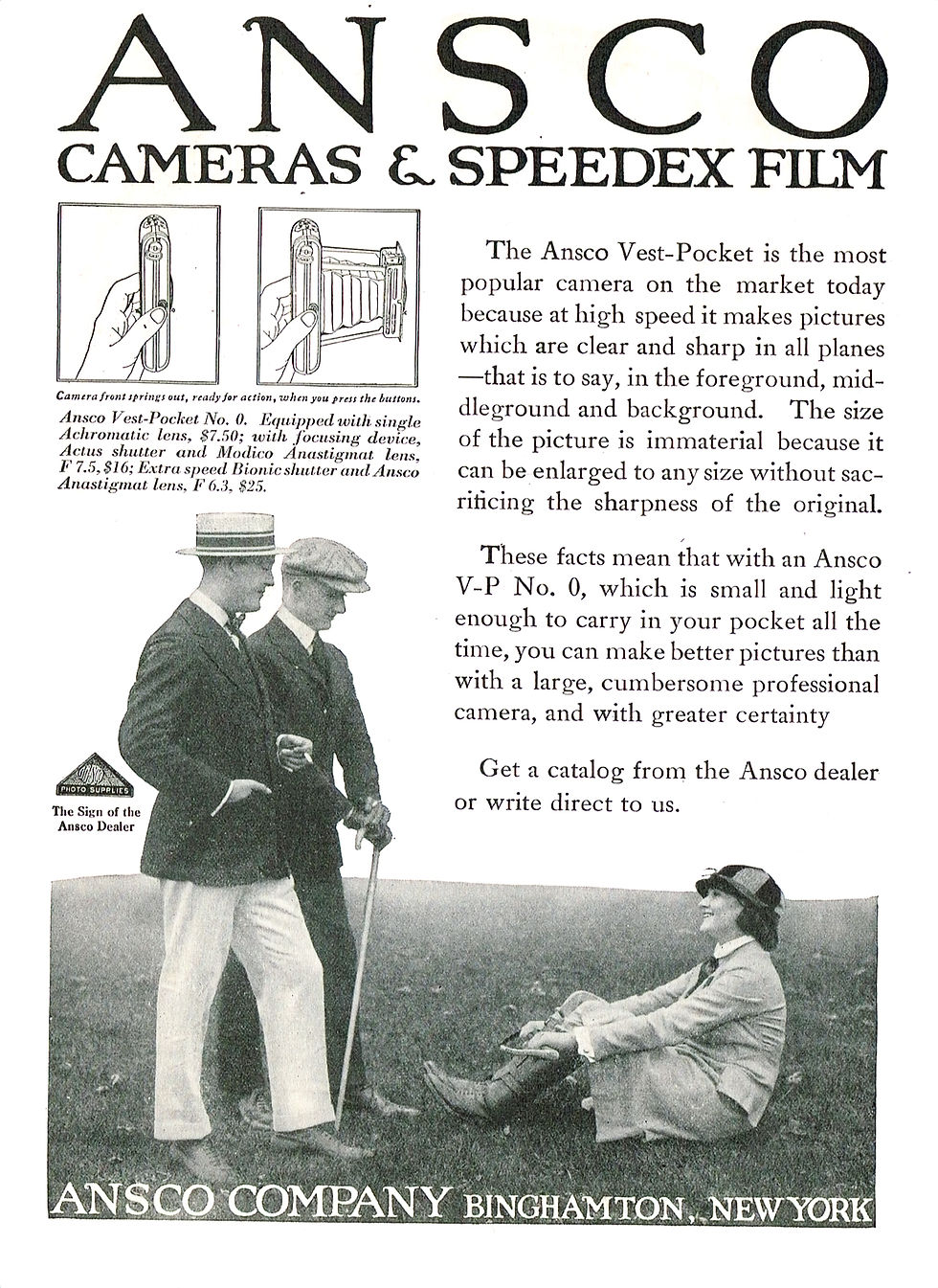
As an owner of German Shepherd dogs and of vintage Ansco strut cameras, this has to be one of my favourite old adverts !

I can also tell you why I bought it. At the time I was putting together a collection of Ensignette strut cameras, the unusual design fascinated me and I knew that these Ansco V.P.'s were very similar indeed to the Ensignettes so much so, that there was some controversy as to who copied the other! They are very, very similar.

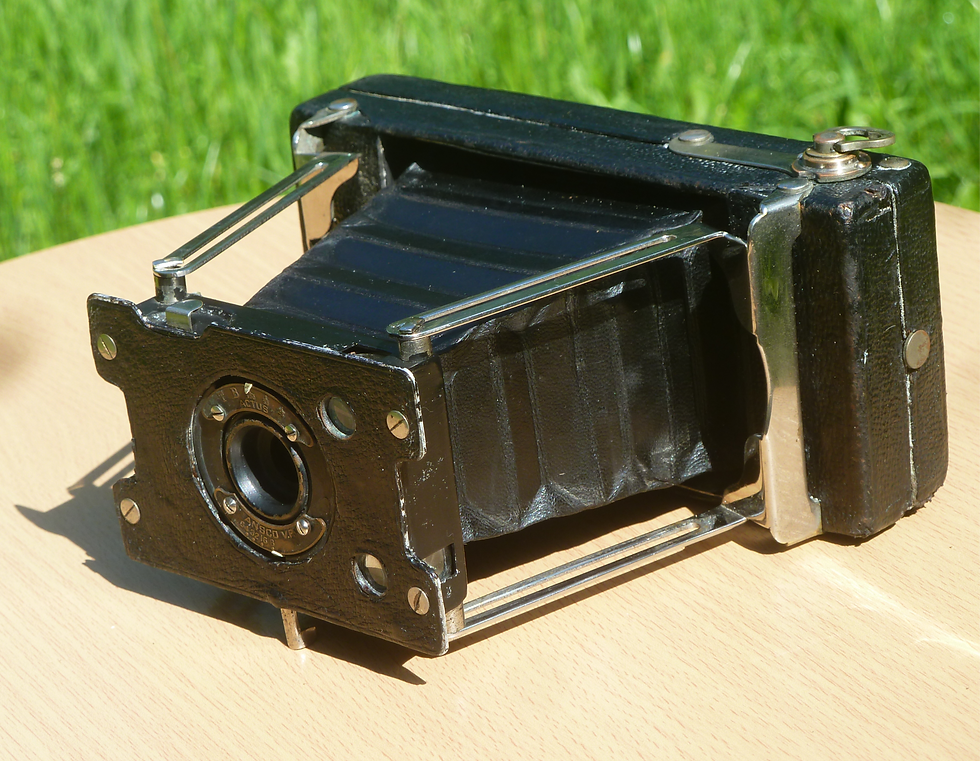
So what do we know then? Well lets start with the American Patent dates. In the back we find four U.S. patents, Nov. 24-1903, Sep. 20-1910, Jun. 11 -1912 and finally Jul. 23-1912. So we can safely say that the camera is around 1912 in date, or to be accurate it was made after July 23 1912!

The shutter has a nameplate, and is called the Actus Shutter. It has speeds of T, B, 100, 50, and 25th of a second. Surprisingly at 100th of a second the shutter still operates, but the other speeds are a bit sticky! It looks likely that Actus shutters were produced for the Ansco V.P. Model A by Wollensak Optical Company, but I can't be 100% certain.
I have really done some digging to find more about this camera, even using AI to try and discover a little more. One thing that did come up using AI was that a version was made using a Bionic shutter, this it seems is more common than the Actus shutter. AI did not come up with much, I spent more time correcting the wrong information than finding out anything new. Back to old books for me!
It looks like the Bionic shutter was produced by Medico for Ansco. It had a slightly better range of speeds. See picture below. This camera looks somewhat later, with a slightly different body with rounded ends.
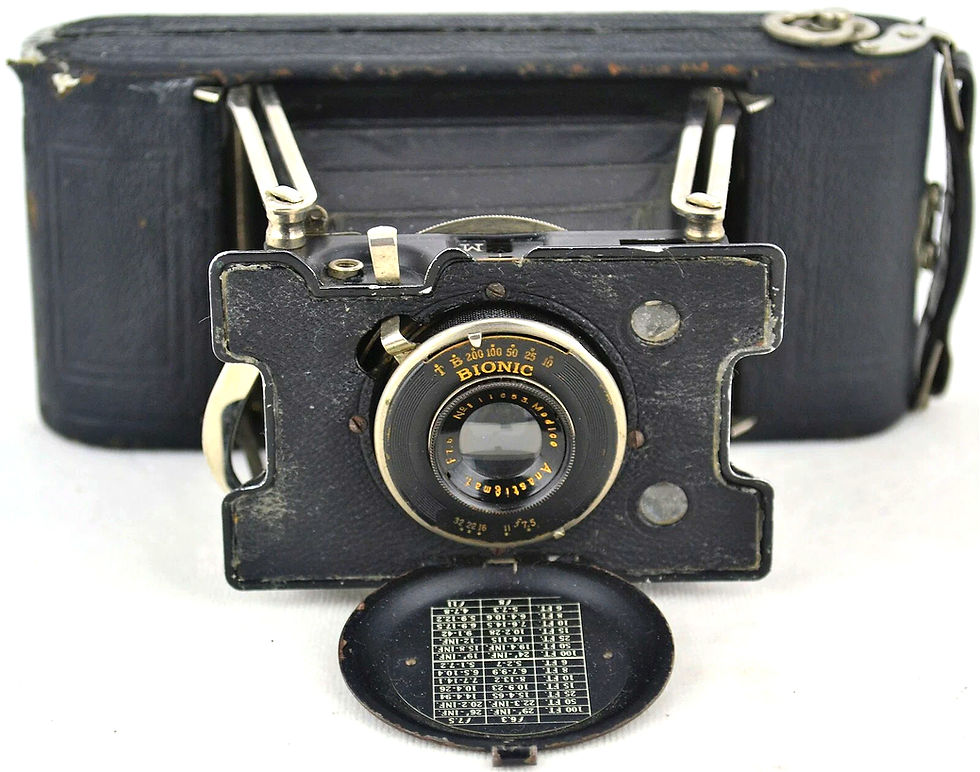

Earlier versions just seem to have a simple instantaneous shutter, whilst my example above had three speeds with the addition of T and B.

The Ansco V.P. model A took six 2 1/4 x 3 1/4 images on Ansco 4A roll film. Ansco 4A being the equivalent to Kodak 120 and Ensign 2 1/4 B films.

It seems by 1915/1916 the body changed from the square edge style pictured above, to a rounded edge as shown in the picture below.


Lets have a look at the Ansco case. Just because I like cases I suppose.

As regular readers of this blog will know, I always try and look at the cameras case, if there is one. The Ansco case is well made, in good condition for one made well over one hundred years ago, but boy was it dry. The leather had really dried out, it has currently had three applications of a hide food, and as you can see in the photo, still looks a little dry. It has started to become much more supple, so another couple of applications of hide food should do the trick.


As you can see they are really quite different cameras !

Even these two very similar versions are quite different when you study then closely. My example below has no Ansco logo stamped into the front panel, has four screw heads visible on the front plate, the shutter front name plates and trim are different, the shutter release is different as is the leather covering. Even the pin for the little stand foot is covered on the top example below, but clearly visible on the example above.

So clearly there were lots of different models and a vast number of production variations on the Ansco V.P. camera. A collectors dream, but a bloggers nightmare trying to sort out the history a hundred and odd years later!


It seems that not many made it over the pond to the shores of Great Britain in those long distant days before the Great War. It's a pity, I like these Ansco strut cameras, they are a good honest working mans camera, that did the job. And the job for many people in those pre-war days was to produce good quality negs that could be contact printed for the family album and at little cost. It looks like it did the job well!
As Colin, the gent from the PCCGB who I bought this camera off way back in 1999, says in his letter,
''it clearly had a fair bit of use - always the sign of a good camera in its day''
I could not have put it better myself, if a camera shows signs of being carefully used a lot, then it obviously produced lots of good images for it previous owner or owners. That is to me always the sign of a good camera.

So, before we wrap up this little ramble, why did we see so few of these cameras on our shores. I'm guessing that Great Britain was not one of Anscos main markets back then in 1912. But also we already had our very similar range of Ensignetts produced by Houghtons, who at the time, had the British Empires largest camera factory right here in London.
In addition to this Murer and Duroni had already got their foot in the door with their Salex series of strut cameras from Italy, so maybe there was just not the room in the market for any more?
Pity the Ansco V.P. Strut cameras is a cracking little camera! I would love to get my hands on one of the later self erecting versions. We forget over here in Europe, America did make some nice cameras, we just did not see many of them here at the time.
Take care,
Phil


Comments