Newman and Guardia Baby Sibyl Plate Camera of 1912-1914
- Kamera Ostalgie

- 1 day ago
- 7 min read
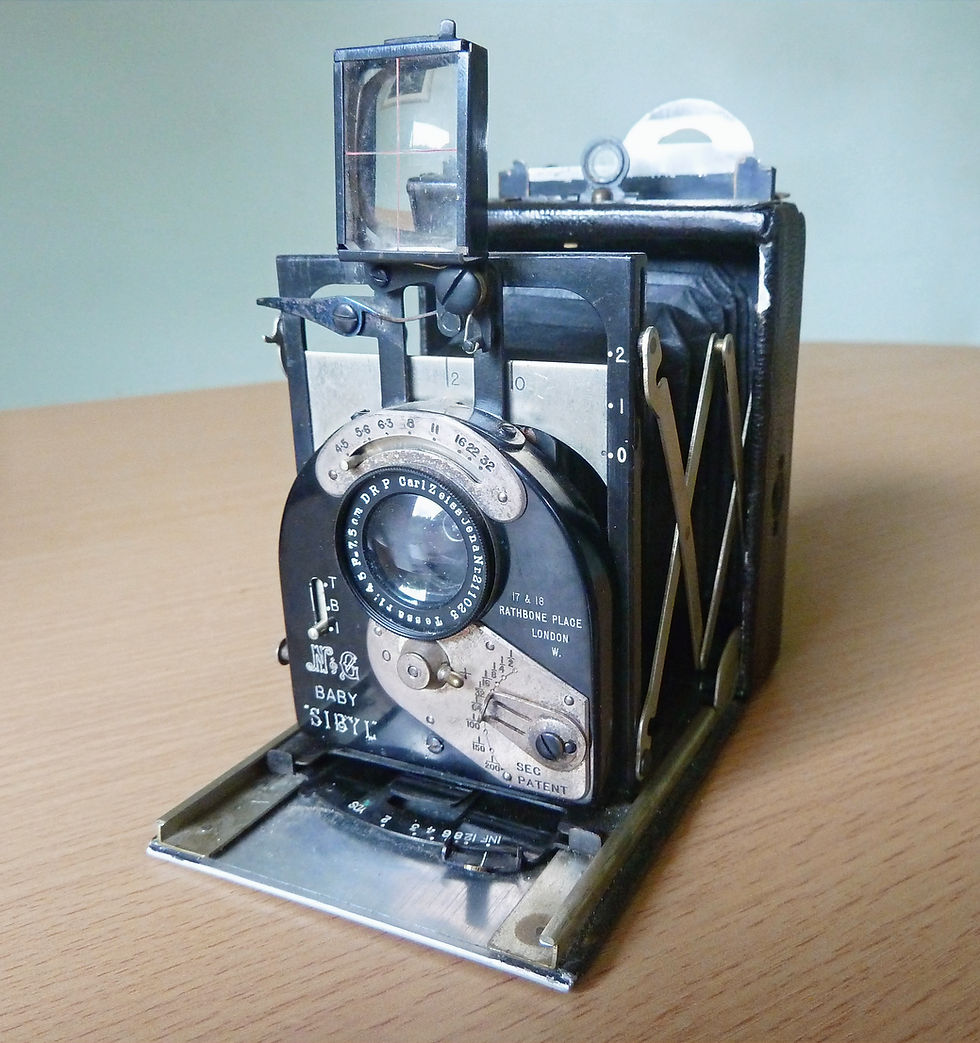
Back in the late 1970's I read a book called 'An Age of Cameras' by Edward Holmes, it was at the time, one of the first 'modern' books on collecting cameras that I had seen. In it, Mr Holmes covered the Sibyl cameras and explained why they were the best folding cameras in the word when they were new. Well that was it, I was hooked on cameras made before 1939, and Newman and Guardia cameras in particular!

There was just one problem I was 18, earning at that time £20 a week and a Baby Sibyl then would have cost me over £200 pounds, even if I could have even located one. So I carried on collecting and using old box cameras and old folders, but I was always on the lookout for a Baby Sibyl ! I found this one, years later, from an old Antique dealer I used to chat with, at Tenant's Salerooms in Leyburn North Yorkshire, but he knew what it was worth!

Newman and Guardia cameras were very unusual cameras to look at, nothing about them was remotely conventional compared to other folding cameras of the period, they had a totally different design, especially in the way the bellows pulled forward on the trellis, guided by the light base panel channels and the very unusual shutter set on a lens panel shaped like a horses shoe. Oh yes, these Sibyls were different. But first lets look at the case !

Even the cases were not the usual folding camera case of the period, no N&G cases were more like a soft pouch rather than a solid stiff hide case. The leather was different, a totally different feel to it, more tactile in a way.

This case has seen a lot of use in its time, but it is still hanging in there, keeping the Baby Sibyl clean and safe.

The Baby Sibyl from the Side showing the film pack adaptor fitted.
They normally took 4.5 x 6cm plates in a double type of plate holder.

A back view showing the film pack adaptor.
All the plates were numbered so that you did not get them mixed up.
I have one plate holder that I bought in addition to my existing ones numbered 17/18. Boy that photographer must have been keen. 18 plates at a time!


The main difference between a N&G folding camera and most other folding cameras of the time, was that the lens standard and bellows pull out and lock into position in a totally different way, the metal channels at each side of the base plate are just guides, the lens panel does not use these channels to hold it firm like most conventional designs, no it locks into position with the spring lock on the black base plate, the channels are just a guide. So where as most lens panels run up and down a rail or rails, the Sibyl does not. Why is this so important ? Well no wear takes place. Usually the pressed lens standard or panel, on most folders, wears or gets sprained from the continual pulling out and pushing in of the lens standard. However carefully you do this, over time some wear or sprain damage occurs. Why is this so important ? Well a worn lens standard is no longer a vertical standard and the natural pull or tension from the bellows will pull back the standard out of the vertical if there is any wear or play. What many people don't realise is, if the lens standard is not vertical, then the resulting image will not be sharp. The centre of the image maybe, but not either end.

Lets dig a bit further into this, if on your conventional folding camera the lens standard is no longer vertical, then your finished picture will not be sharp, if it is only slightly out from a vertical state, your image will, lets say, not be as sharp as it could be, or if there is a great deal of wear and your lens standard is noticeably out of the vertical seen by the rack of your own eye, or you can feel the play, then your images from that particular camera will never be sharp. This is were the N&G cameras and others that do not use a design where the standard wears against its rails or channels have the advantage, the lens panel is truly vertical and the lens is as sharp as it can be in on a folding camera.

So then, there is no point using any conventionally designed folding camera if there is wear on the lens standard and it has wag and is no longer vertical. You might have a fantastic folder fitted with the best Tessar lens in a great Compur Rapid shutter, but if that lens standard is not 100% vertical, the lens will never perform to its best ability. This is why the N&G Sibyl design is so superior.
I like reading current blogs where people try out old folders, it's interesting and fun, I love trying out old folders myself, but most of these bloggers totally disregard the worn lens standard, it is never brought up as a possible fault or cause of poor pictures, even when they get poor results back, they get the optics cleaned which helps, but very rarely do they think of the lens standard being no longer vertical as the cause, or even as a contributory factor to the problem!

Getting back to this Baby Sibyl, the lens on this example is a Carl Zeiss Jena Tessar of f4.5 and 7.5cm focal length. The lens number is 211025. The Tessar lens will put this camera as being made before 1914. The body number is early, being B 260, so I would guess that this little Sibyl came out of Mr Newman's workshop between 1912 and 1914. The address on the front standard is 17&18 Rathbone Place London W. Newman and Guardia were at this address between 1909 and 1929.
Up to the start of the Great War, N&G tended to use German lenses in their shutters as they were thought of as the best available. However the war put a stop to that and N&G had to start using the best British lenses available, such as the Ross Xpres from Ross of London.

The shutter is another N&G one off design! It is a spring powered rotary sector type, but with pneumatic regulation of its speeds, which are, 1/2, 1/4, 1/8, 1/16, 1/32, 1/64, 1/100, 1/200th plus T and B. Another unusual thing with the shutter is that N&G referred to the B setting as Ball, not the usual Bulb. Could this be linked to Kodak cameras of the period that also used B as ball, presumably linked to Kodaks ball bearing shutters? I don't know, please leave me your suggestions in the comments section if you have any ideas. The comments section is free and it does note bite!
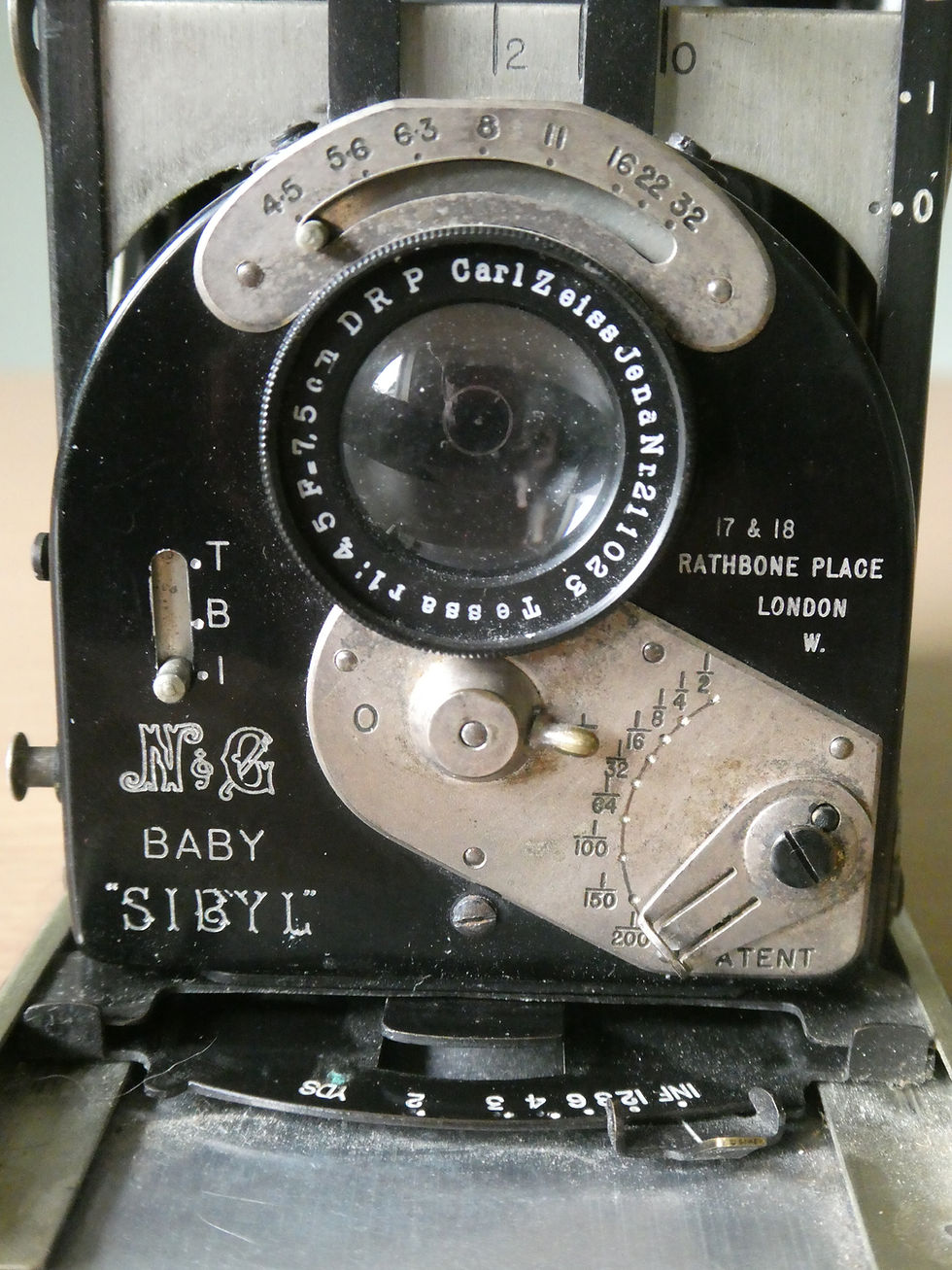
Lets look further at this shutter! Go on indulge me. The shutter is charged or set by matching up the 0, which you can see through the lens, with the 0 on German Silver Plate as N&G called it, underneath the lens. You do this by the capstan lever on the silver plate. On the picture above, the shutter is not set, so to do this you would have to move this lever to 0 too. Then the shutter is set. If the + sign was seen behind the lens then the lever needs turning to +! Then you press the shutter release, which is on the side of the front plate next to the N&G logo! Of course the button on front of the plate needs to be at 'I' for any of the shutter speeds between 1/2 and 1/200th of a second.

To adjust the focus, then you move the little black lever on the base plate, left for infinity, right for 12, 8, 6, 4, 3, and 2 yards. Yep, yards! Not feet or metres, yards. This is England pre 1914!
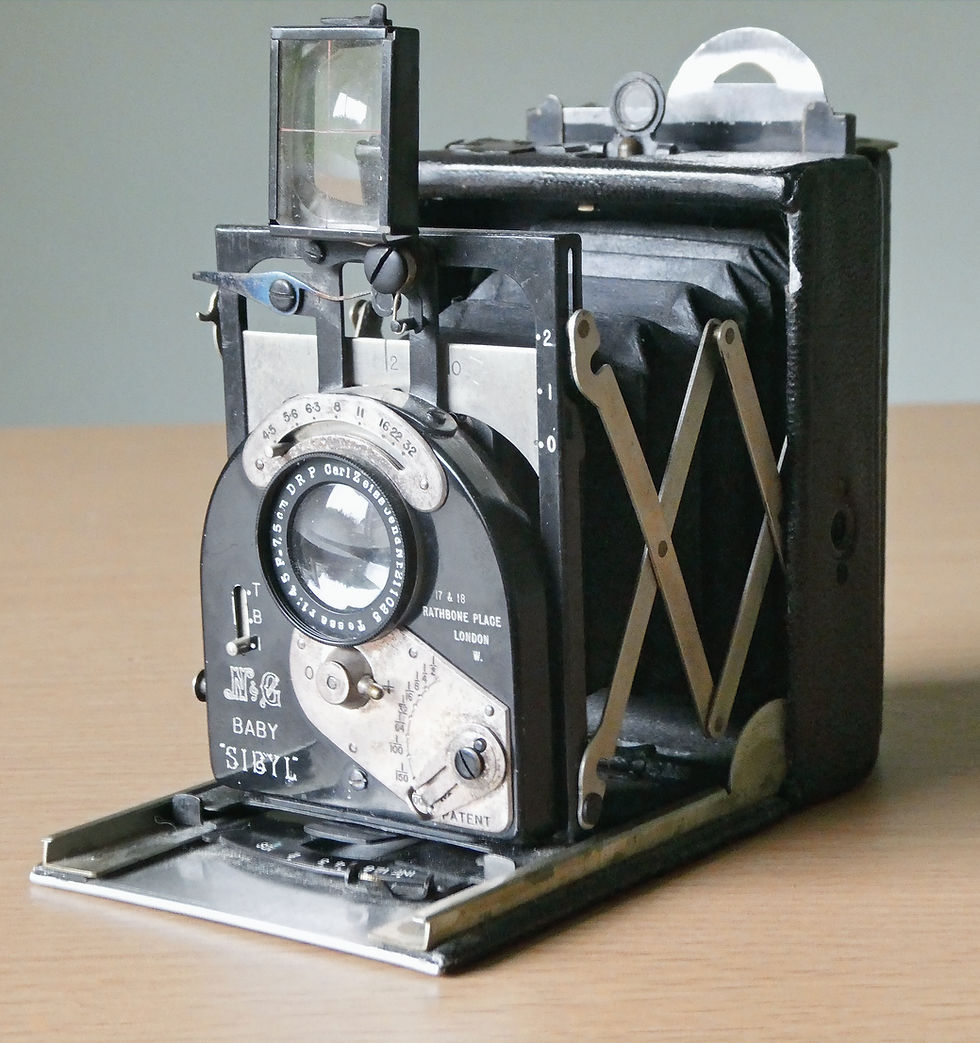
Apertures of 4.5, 5.6, 6.3, 8, 16, 22, and 32 can be selected by using the little lever above the lens, we can have a closer look below.


It is definitely worth looking at any N&G camera, they are all very unusual and individual designs. They have however always been expensive. They were when new, they were forty years ago, and they are now. A plate version of the Baby Sibyl today would set you back around £400 for a well used one and up to £800 for a nice lightly used one. Faults ? The leather body covering can be prone to wear, but the bellows are usually good. Well used ones often suffer from the German Silver around the shutter controls being worn through to the brass, some get cleaned with metal polish, which ruins the German Silver, oh and plate versions tend to loose their ground glass holder for some reason, like my example. Apart from that, they are pretty robust, the shutters usually are still working.

There is a roll film version of the Baby Sibyl, unfortunately I don't have one, they usually are a little bit more expensive than the plate versions which seem to be slightly more common.

I do however have this roll film New Ideal Sibyl ! But that might have to be a post for another day!

Oh dear, what a beast of a camera it is! Anyway, that sort of brings to an end the post about the Baby Sibyl plate camera. You know it was the easiest post I have ever written! I could write pages on N&G sibyls !
Hope you liked this quick look at them, click on like if you did and don't forget to leave a comment if you so wish.

Sometimes you know, I feel like selling all my collection and just collecting N&G cameras ! They are so great. There are just three things stopping me, one, all the good ones are already in other peoples collections, two, if I sold all my collection of cameras, I would only be able to buy a couple more N&G's with the money! Three, I get loads of fun from my simple box cameras and old folders that are worth nothing in comparison!
Take care,
Phil


Comments